A Levels Biology (9700)•9700/13/M/J/21
A Levels Biology (9700) — 9700/13/M/J/21, Question 16
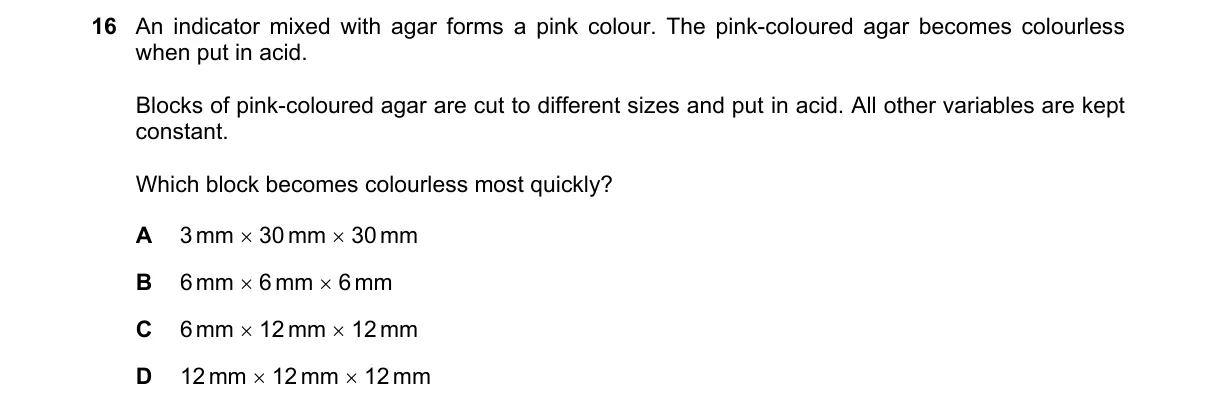
An indicator mixed with agar forms a pink colour. The pink-coloured agar becomes colourless when put in acid. Blocks of pink-coloured agar are cut to different sizes and put in acid. All other variables are kept constant. Which block becomes colourless most quickly?
Answer choices
- A3 mm × 3 mm × 3 mm
- B6 mm × 6 mm × 6 mm
- C6 mm × 12 mm × 12 mm
- D12 mm × 12 mm × 12 mm
Explanation
Diffusion rate depends on surface area to volume ratio
Steps:
- Acid diffuses into agar from the surface, decolorizing the indicator.
- Smaller blocks have higher surface area relative to volume, allowing faster diffusion.
- Calculate SA/V for each: A (3×3×3) = 6.00 mm⁻¹; B (6×6×6) = 3.00 mm⁻¹; C (6×12×12) = 1.75 mm⁻¹; D (12×12×12) = 1.50 mm⁻¹.
- Highest SA/V means quickest color change.
Why A is correct:
- A has the highest SA/V ratio (6.00 mm⁻¹), maximizing acid penetration speed per Fick's law of diffusion.
Why the others are wrong:
- B: Lower SA/V (3.00 mm⁻¹) than A, so slower diffusion.
- C: Even lower SA/V (1.75 mm⁻¹) due to elongated shape, reducing relative surface exposure.
- D: Lowest SA/V (1.50 mm⁻¹), minimizing diffusion rate.
Final answer: A
Topic: Movement into and out of cells
Practice more A Levels Biology (9700) questions on mMCQ.me