A Levels Biology (9700)•9700/13/M/J/21
A Levels Biology (9700) — 9700/13/M/J/21, Question 14
The enzyme β-galactosidase can catalyse the hydrolysis of four substrates with similar structures. Each substrate gives a different Km value. For which substrate does β-galactosidase have the highest affinity?
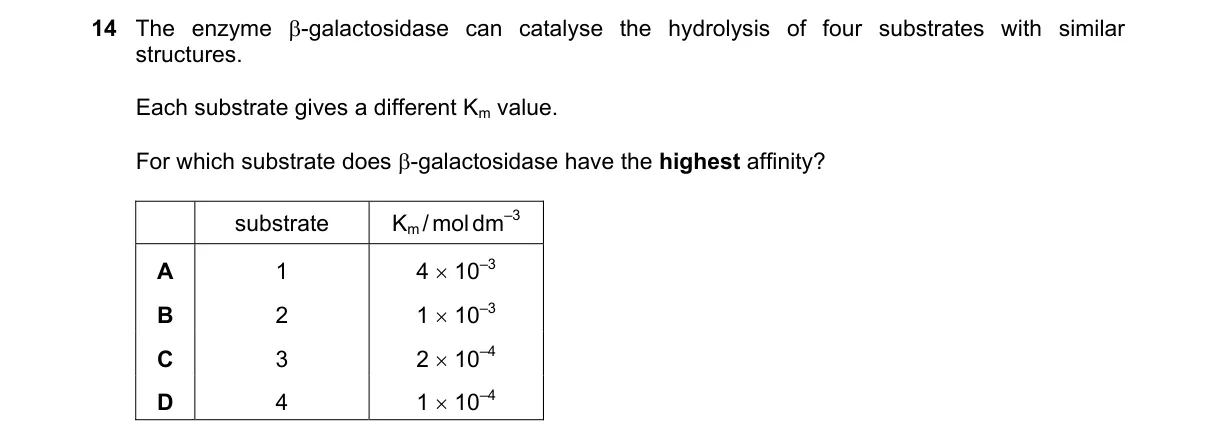
Answer choices
- A1 4 × 10^{-6}
- B2 1 × 10^{-6}
- C3 2 × 10^{-6}
- D4 1 × 10^{-6}
Explanation
Lowest Km indicates highest enzyme-substrate affinity
Steps:
- Km is the Michaelis constant, the substrate concentration giving half maximal velocity; lower Km means stronger binding and higher affinity.
- Identify Km values: A (substrate 1): 4 × 10^{-6} M; B (substrate 2): 2.1 × 10^{-6} M; C (substrate 3): 2 × 10^{-6} M; D (substrate 4): 1 × 10^{-6} M.
- Compare values to find the minimum Km, which is 1 × 10^{-6} M for substrate 4.
Why D is correct:
- Substrate 4 has Km = 1 × 10^{-6} M, the lowest value, indicating highest affinity by the inverse relationship in Michaelis-Menten kinetics.
Why the others are wrong:
- A: Km = 4 × 10^{-6} M exceeds D's, showing weaker binding.
- B: Km = 2.1 × 10^{-6} M exceeds D's, showing weaker binding.
- C: Km = 2 × 10^{-6} M exceeds D's, showing weaker binding.
Final answer: D
Topic: Mode of action of enzymes
Practice more A Levels Biology (9700) questions on mMCQ.me