A Levels Biology (9700)•9700/12/M/J/21
A Levels Biology (9700) — 9700/12/M/J/21, Question 33
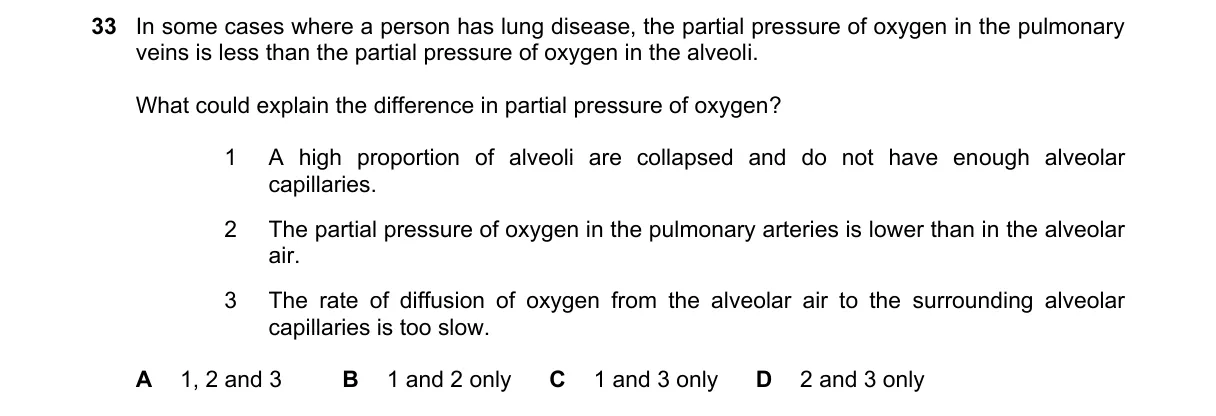
In some cases where a person has lung disease, the partial pressure of oxygen in the pulmonary veins is less than the partial pressure of oxygen in the alveoli. What could explain the difference in partial pressure of oxygen?
1. A high proportion of alveoli are collapsed and do not have enough alveolar ventilation.
2. The partial pressure of oxygen in the pulmonary arteries is lower than in the alveolar air.
3. The rate of diffusion of oxygen from the alveolar air to the surrounding alveolar capillaries is too slow.
Answer choices
- A1, 2 and 3
- B1 and 2 only
- C1 and 3 only
- D2 and 3 only
Explanation
Ventilation-perfusion mismatch and diffusion impairment
Steps:
- In healthy lungs, alveolar PO2 exceeds venous PO2, allowing oxygen diffusion into blood until equilibrium near alveolar levels.
- Lung disease can cause collapsed alveoli (atelectasis), reducing ventilation and preventing full oxygenation of blood.
- Slow diffusion across thickened alveolar-capillary membranes, as in fibrosis, limits oxygen transfer, lowering pulmonary venous PO2.
- Arterial PO2 being lower than alveolar is normal due to mixed venous blood, not a disease explanation for the discrepancy.
Why C is correct:
- Per Fick's law of diffusion, impaired ventilation (option 1) and reduced diffusion rate (option 3) directly lower oxygen equilibration in blood, matching the observed venous-alveolar PO2 gradient.
Why the others are wrong:
- A includes option 2, which describes normal physiology, not a pathological cause.
- B omits diffusion impairment and relies on normal arterial-alveolar difference.
- D excludes ventilation issues, focusing only on normal and diffusion factors.
Final answer: C
Topic: The gas exchange system
Practice more A Levels Biology (9700) questions on mMCQ.me