A Levels Biology (9700)•9700/12/M/J/21
A Levels Biology (9700) — 9700/12/M/J/21, Question 30
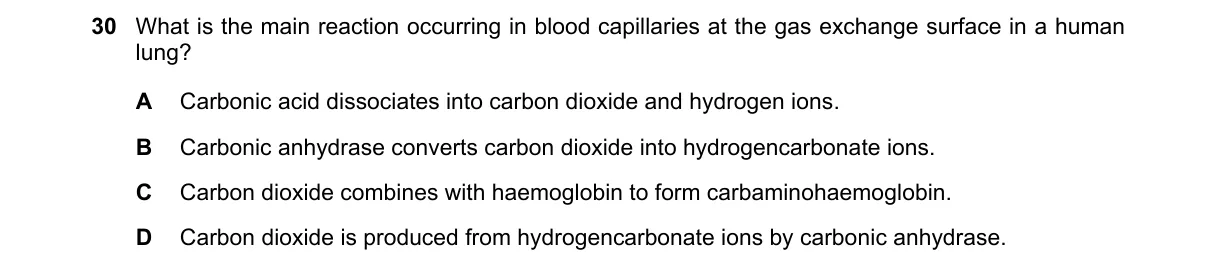
What is the main reaction occurring in blood capillaries at the gas exchange surface in a human lung?
Answer choices
- ACarbonic acid dissociates into carbon dioxide and hydrogen ions.
- BCarbonic anhydrase converts carbon dioxide into hydrogencarbonate ions.
- CCarbon dioxide combines with haemoglobin to form carbamino haemoglobin.
- DCarbon dioxide is produced from hydrogencarbonate ions by carbonic anhydrase.
Explanation
CO2 Release in Lung Capillaries
Steps:
- Identify gas exchange in lungs: O2 enters blood, CO2 exits to alveoli.
- Recall CO2 transport: In tissues, CO2 forms HCO3- via carbonic anhydrase for blood carry.
- In lungs, low CO2 partial pressure reverses process: HCO3- converts back to CO2.
- Confirm enzyme role: Carbonic anhydrase catalyzes HCO3- + H+ → H2CO3 → CO2 + H2O.
Why D is correct:
- In lungs, carbonic anhydrase reverses bicarbonate formation (HCO3- + H+ ⇌ H2CO3 ⇌ CO2 + H2O), releasing CO2 for diffusion into alveoli.
Why the others are wrong:
- A: Dissociation of H2CO3 to CO2 + H+ occurs in tissues, not lungs.
- B: CO2 to HCO3- happens in tissues for transport, opposite in lungs.
- C: Carbaminohemoglobin forms in tissues; in lungs, it releases CO2.
Final answer: D
Topic: Transport of oxygen and carbon dioxide
Practice more A Levels Biology (9700) questions on mMCQ.me