A Levels Biology (9700)•9700/12/M/J/21
A Levels Biology (9700) — 9700/12/M/J/21, Question 25
A student wanted to find out the rate of transpiration using a potometer as shown. The student was told to work out a value for transpiration using the units mm³ m⁻² h⁻¹. Which measurements would the student need to take?
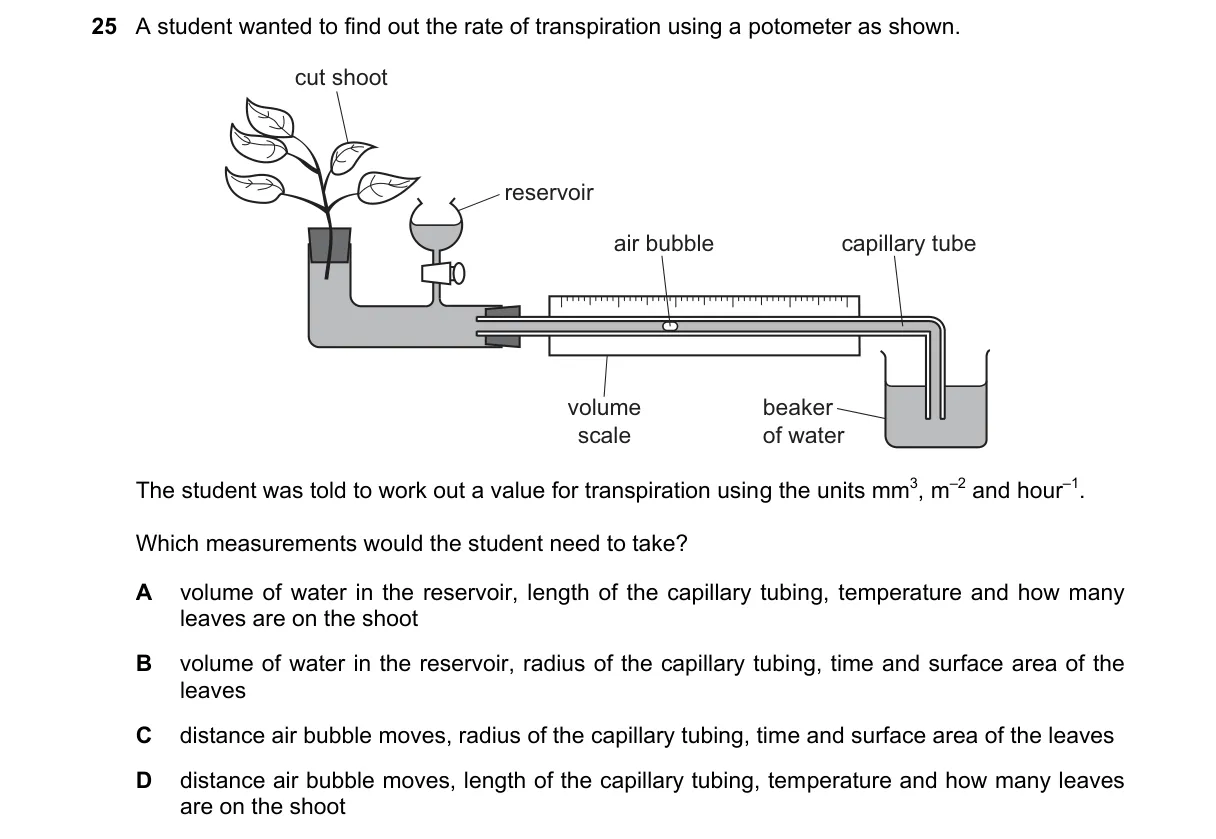
Answer choices
- Avolume of water in the reservoir, length of the capillary tube, temperature and how many leaves are on the shoot
- Bvolume of water in the reservoir, radius of the capillary tube, time and surface area of the leaves
- Cdistance air bubble moves, radius of the capillary tube, time and surface area of the leaves on the shoot
- Dvolume of water in the reservoir, length of the capillary tube, temperature and how many leaves
Explanation
Calculating transpiration rate from potometer data
Steps:
- Measure distance the air bubble moves in the capillary tube to determine water uptake volume via π r² × distance.
- Use radius of the capillary tube to calculate its cross-sectional area for volume computation.
- Record time taken for the bubble movement to find volume per hour.
- Measure surface area of leaves on the shoot to normalize rate per square meter.
Why C is correct:
- Transpiration rate = (volume of water / time) / leaf area, where volume = π r² × distance moved, matching mm³ m⁻² h⁻¹ units.
Why the others are wrong:
- A: Reservoir volume and tube length are irrelevant; temperature and leaf count do not yield precise area or volume.
- B: Reservoir volume does not measure uptake; bubble distance is needed for accurate volume.
- D: Lacks bubble distance and leaf area; temperature and leaf count are insufficient for rate calculation.
Final answer: C
Topic: Transport mechanisms
Practice more A Levels Biology (9700) questions on mMCQ.me