A Levels Biology (9700)•9700/12/M/J/21
A Levels Biology (9700) — 9700/12/M/J/21, Question 20
A short piece of DNA 18 base pairs long was analysed to find the number of nucleotide bases in each polynucleotide strand. Some of the results are shown in the table.
| Strand 1 | Adenine | Cytosine | Guanine | Thymine |
|----------|---------|----------|---------|---------|
| Strand 1 | 4 | | 5 | 7 |
How many nucleotides containing thymine are present in strand 2?
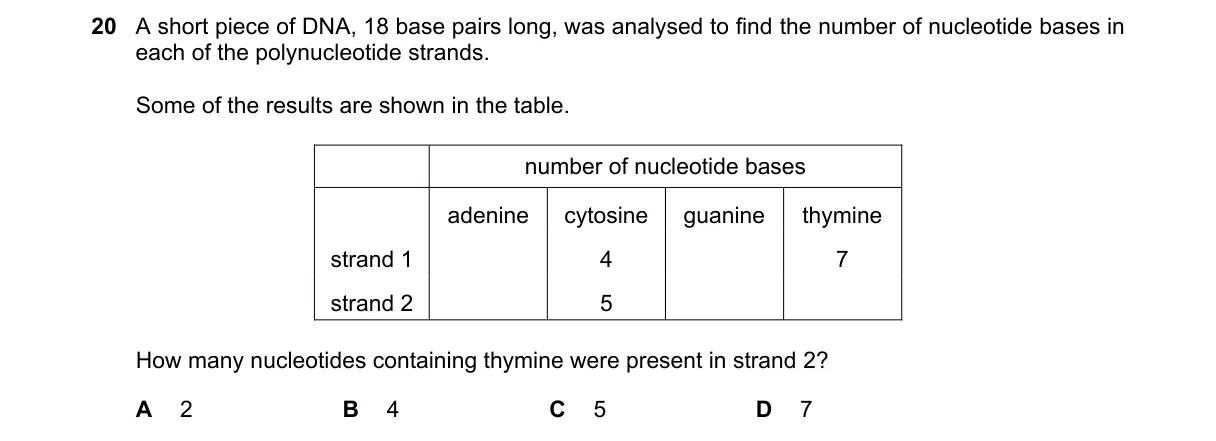
Answer choices
- A2
- B4
- C5
- D7
Explanation
DNA complementary base pairing
Steps:
- DNA double helix has 18 base pairs, so each strand contains 18 nucleotides.
- For strand 1, add given bases: adenine (4) + guanine (5) + thymine (7) = 16; cytosine = 18 - 16 = 2.
- Complementary base pairing rule: adenine pairs with thymine, cytosine with guanine.
- Thus, thymine in strand 2 equals adenine in strand 1, which is 4.
Why B is correct:
- In DNA, adenine on one strand pairs with thymine on the complementary strand (Watson-Crick base pairing).
Why the others are wrong:
- A: 2 is cytosine count in strand 1, which pairs with guanine in strand 2.
- C: 5 is guanine count in strand 1, which pairs with cytosine in strand 2.
- D: 7 is thymine count in strand 1, which pairs with adenine in strand 2.
Final answer: B
Topic: Structure of nucleic acids and replication of DNA
Practice more A Levels Biology (9700) questions on mMCQ.me