A Levels Biology (9700)•9700/12/M/J/21
A Levels Biology (9700) — 9700/12/M/J/21, Question 12
The diagram shows sucrose and sucralose. The enzyme sucrase breaks down sucrose but cannot break down sucralose. Four students were asked to suggest why sucrase can break down sucrose but not sucralose. Three of the students gave correct suggestions.
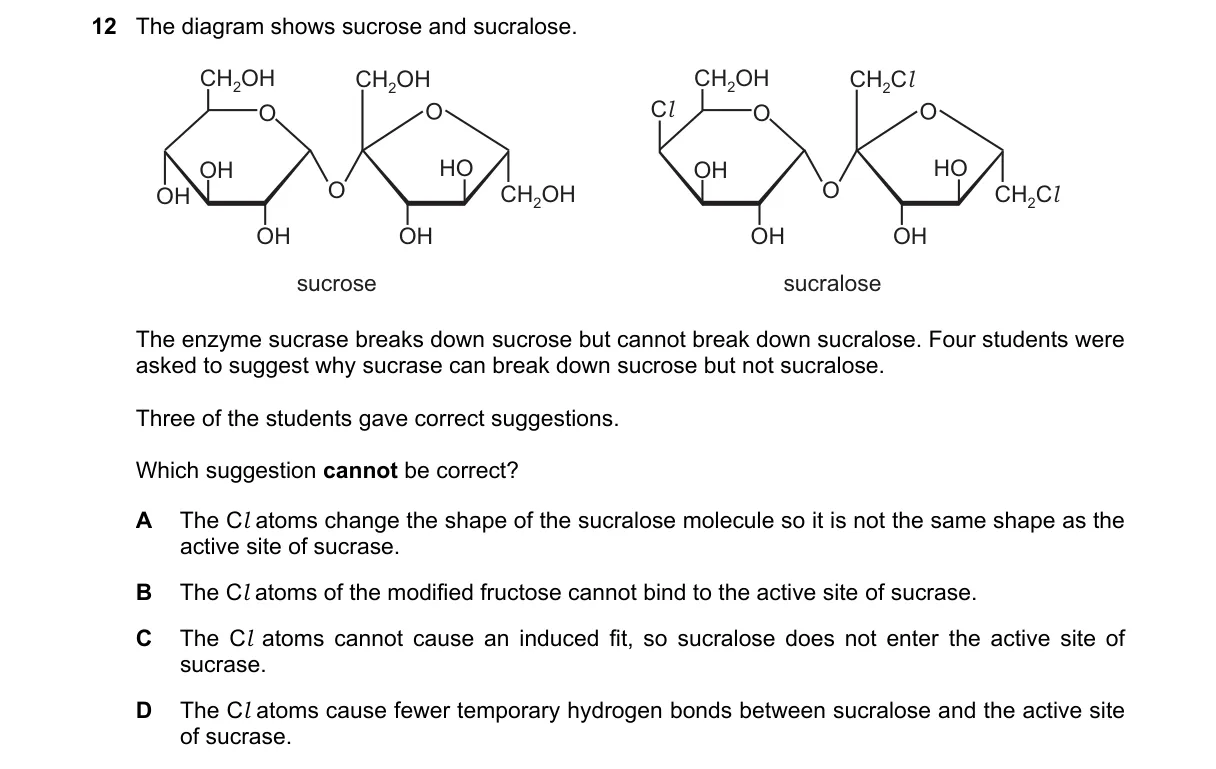
Answer choices
- AThe Cl atoms change the shape of the sucralose molecule so it is not the same shape as the active site of sucrase.
- BThe Cl atoms of modified fructose cannot bind to the active site of sucrase.
- CThe Cl atoms cannot cause an induced fit, so sucralose does not enter the active site of sucrase.
- DThe Cl atoms cause fewer temporary hydrogen bonds between sucralose and the active site of sucrase.
Explanation
Enzyme-Substrate Shape Mismatch Steps:
- Sucrose fits sucrase's active site due to complementary 3D shape.
- Sucralose replaces three OH groups with Cl atoms, altering molecular geometry.
- Enzymes require precise shape match for binding (lock-and-key model).
- Shape change prevents sucralose from entering or binding to active site.
Why A is correct:
- Lock-and-key hypothesis states active site shape must complement substrate; Cl atoms distort sucralose, eliminating fit.
Why the others are wrong:
- B: Binding failure affects entire molecule, not just modified fructose part.
- C: Induced fit requires initial binding, which shape mismatch blocks first.
- D: Fewer H-bonds may contribute, but core issue is overall shape incompatibility.
Final answer: A
Topic: Mode of action of enzymes
Practice more A Levels Biology (9700) questions on mMCQ.me