A Levels Biology (9700)•9700/11/M/J/21
A Levels Biology (9700) — 9700/11/M/J/21, Question 6
The very large (1000 nm) Pandora viruses found in Chile and Australia are considered to be viruses because they cannot replicate their genome and cannot make proteins. They also share essential structural features with other viruses. What are the essential structural features of viruses? 1 non-cellular structure 2 protein coat 3 both DNA and RNA 4 either DNA or RNA
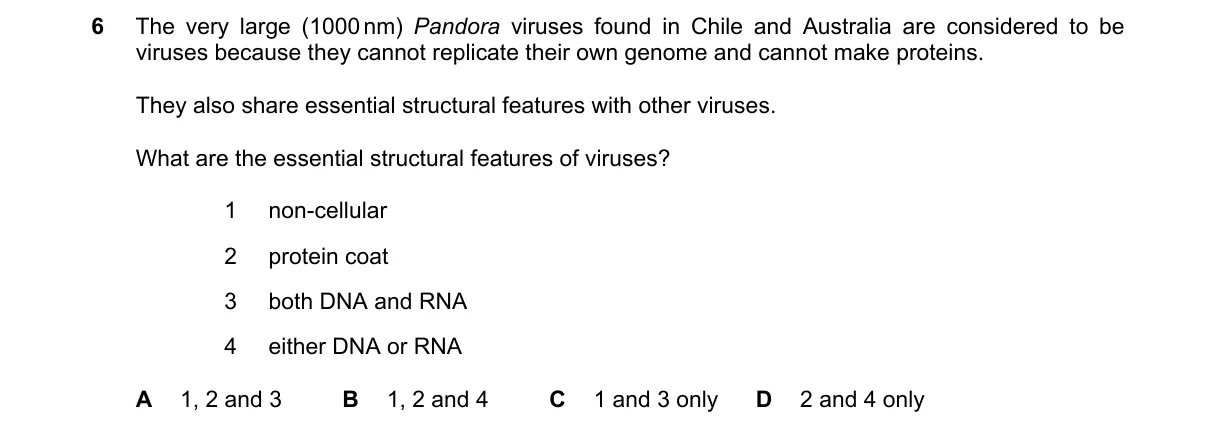
Answer choices
- A1,2 and 3
- B1 and 4
- C1 and 3
- D2 and 4 only
Explanation
Defining Viral Structure
Steps:
- Viruses are obligate intracellular parasites lacking cellular organization, confirming non-cellular structure (1).
- All viruses possess a protein capsid enclosing genetic material, verifying protein coat (2).
- Viruses contain a single type of nucleic acid—either DNA or RNA, not both—ruling out both (3) and supporting either (4).
- Cross-reference options: B combines accurate features (1 and 4) while excluding errors.
Why B is correct:
- By virology definition, viruses are acellular (1) with a genome of either DNA or RNA (4), distinguishing them from cells.
Why the others are wrong:
- A: Includes 3, but viruses never have both DNA and RNA genomes.
- C: Includes 3 (incorrect) and omits protein coat (2) and either nucleic acid (4).
- D: Omits non-cellular structure (1), a core viral trait.
Final answer: B
Topic: Infectious diseases
Practice more A Levels Biology (9700) questions on mMCQ.me