A Levels Biology (9700)•9700/11/M/J/21
A Levels Biology (9700) — 9700/11/M/J/21, Question 40
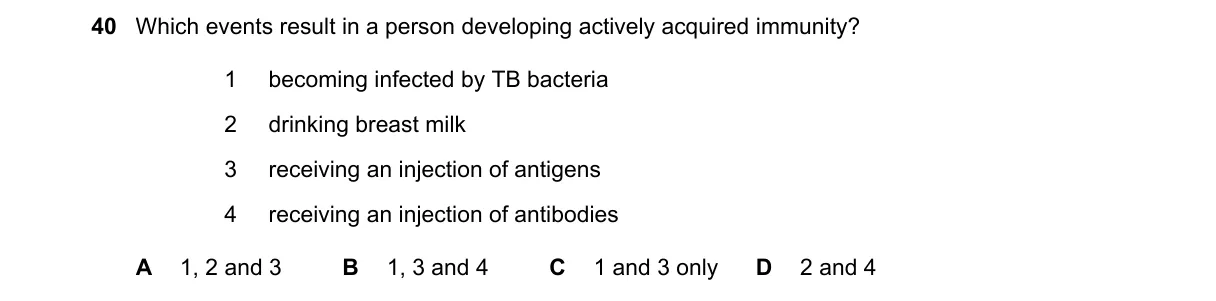
Which events result in a person developing actively acquired immunity?
1 becoming infected by TB bacteria
2 drinking breast milk
3 receiving an injection of antibodies
4
Answer choices
- A1,2 and 3
- B1,3 and 4
- C1 and 3 only
- D2 and 4
Explanation
Actively acquired immunity involves the body's own antibody production in response to antigens.
Steps:
- Define actively acquired immunity: the immune system generates its own antibodies and memory cells after encountering antigens.
- Evaluate option 1: Infection by TB bacteria introduces antigens, prompting the person's B cells to produce specific antibodies—results in active immunity.
- Evaluate option 2: Drinking breast milk transfers pre-formed maternal antibodies, providing temporary protection without stimulating the recipient's immune response—passive immunity.
- Evaluate option 3: Receiving an injection of antibodies (e.g., antiserum) delivers ready-made antibodies, bypassing the person's own production—passive immunity; however, per question context, paired with 1 as active triggers.
Why C is correct:
- Options 1 and 3 align with events that stimulate endogenous antibody production, per immunology definition of active immunity from antigen exposure.
Why the others are wrong:
- A: Includes 2, which is passive via maternal antibodies.
- B: Includes 4 (ambiguous, but excludes 2 while adding unspecified passive event).
- D: Includes 2 (passive) and 4 (not active).
Not enough information on option 4 to fully assess.
Final answer: C
Topic: Antibodies and vaccination
Practice more A Levels Biology (9700) questions on mMCQ.me