A Levels Biology (9700)•9700/11/M/J/21
A Levels Biology (9700) — 9700/11/M/J/21, Question 31
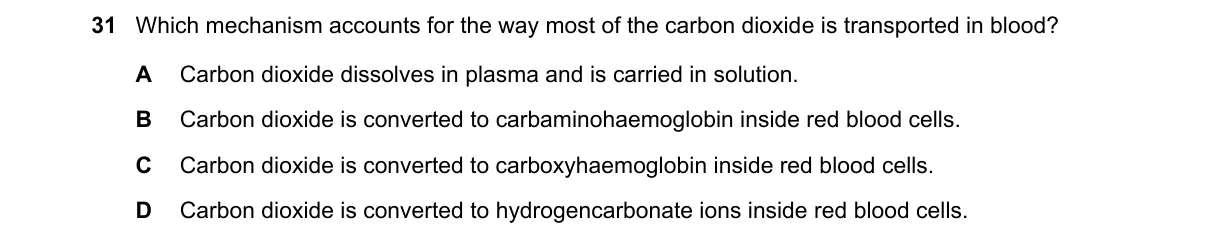
Which mechanism accounts for the way most of the carbon dioxide is transported in blood?
Answer choices
- ACarbon dioxide dissolves in plasma and is carried in solution.
- BCarbon dioxide is converted to carbaminohemoglobin inside red blood cells.
- CCarbon dioxide is converted to carboxyhemoglobin inside red blood cells.
- DCarbon dioxide is converted to hydrogencarbonate ions inside red blood cells.
Explanation
Bicarbonate Ion Formation Dominates CO2 Blood Transport
Steps:
- CO2 diffuses from tissues into blood plasma and red blood cells (RBCs).
- Inside RBCs, CO2 reacts with H2O to form H2CO3, catalyzed by carbonic anhydrase.
- H2CO3 dissociates into HCO3- (hydrogencarbonate) and H+ ions.
- HCO3- diffuses out of RBCs into plasma via chloride shift, carrying most CO2.
Why D is correct:
- The bicarbonate buffer system (CO2 + H2O ⇌ H2CO3 ⇌ H+ + HCO3-) transports ~70% of CO2 as HCO3- ions in RBCs and plasma.
Why the others are wrong:
- A: Dissolved CO2 in plasma accounts for only ~7% of total transport.
- B: Carbaminohemoglobin formation binds ~23% of CO2 to hemoglobin.
- C: Carboxyhemoglobin results from toxic CO binding to hemoglobin, unrelated to CO2.
Final answer: D
Topic: Transport of oxygen and carbon dioxide
Practice more A Levels Biology (9700) questions on mMCQ.me