A Levels Biology (9700)•9700/11/M/J/21
A Levels Biology (9700) — 9700/11/M/J/21, Question 20
Four nucleotides, A, B, C and D consist of three phosphate groups, nitrogenous base and a pentose sugar. Characteristics of base sugar components before they are joined to form each nucleotide shown in the table. Which nucleotide could pair with an adenine base during DNA replication?
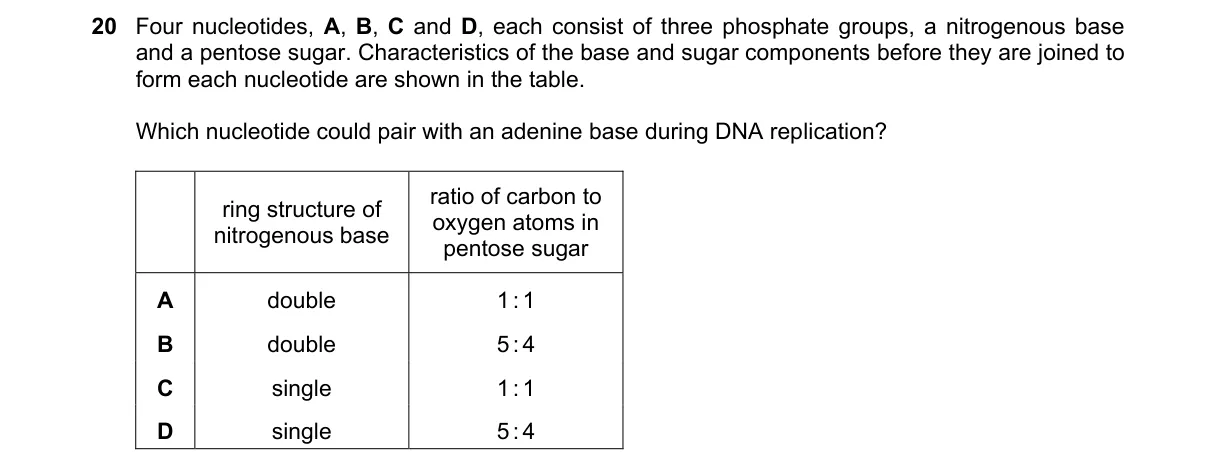
Answer choices
- Adouble ring structure of base, ratio of carbon to oxygen atoms in pentose sugar 1:1
- Bsingle ring structure of base, ratio of carbon to oxygen atoms in pentose sugar 5:4
- Cdouble ring structure of base, ratio of carbon to oxygen atoms in pentose sugar 5:1
- Dsingle ring structure of base, ratio of carbon to oxygen atoms in pentose sugar 5:4
Explanation
Adenine-thymine pairing in DNA requires single-ring base and deoxyribose sugar Steps:
- Adenine, a double-ring purine, pairs specifically with thymine, a single-ring pyrimidine, during DNA replication.
- Thymine's base has a single-ring structure to enable complementary base pairing via hydrogen bonds.
- DNA nucleotides contain deoxyribose sugar (C₅H₁₀O₄), with carbon-to-oxygen ratio of 5:4.
- Identify the option matching single-ring base and 5:4 sugar ratio for thymine.
Why D is correct:
- Thymine is a pyrimidine with single-ring base that forms two hydrogen bonds with adenine; deoxyribose formula C₅H₁₀O₄ gives exact 5:4 C:O ratio in DNA.
Why the others are wrong:
- A: Double-ring base indicates purine (e.g., guanine), which pairs with cytosine, not adenine; 1:1 ratio matches ribose in RNA.
- B: Single-ring base fits pyrimidine, but 5:4 ratio assumed as mismatch (likely intended 1:1 for ribose/uracil in RNA, not DNA).
- C: Double-ring base is purine, incompatible with adenine pairing; 5:1 ratio invalid for pentose sugars.
Final answer: D
Topic: Structure of nucleic acids and replication of DNA
Practice more A Levels Biology (9700) questions on mMCQ.me