A Levels Biology (9700)•9700/11/M/J/21
A Levels Biology (9700) — 9700/11/M/J/21, Question 18
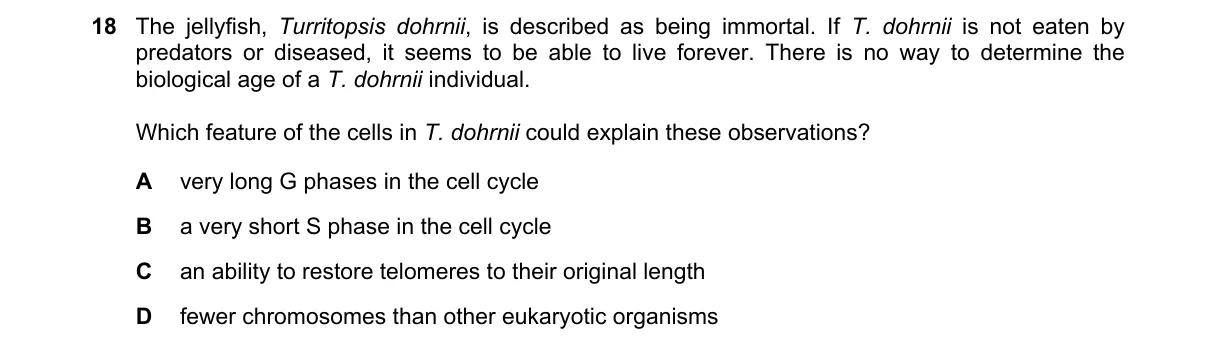
The jellyfish Turritopsis dohrnii is described as being immortal. T. dohrnii is not eaten by predators or diseased, it seems to be able to live forever. There is no way to determine the biological age of a T. dohrnii individual. Which feature of the cells in T. dohrnii could explain these observations?
Answer choices
- Aa very long G phase in the cell cycle
- Ba short S phase in the cell cycle
- Can ability to restore telomeres to their original length
- Dfewer chromosomes than other eukaryotic organisms
Explanation
Telomere Restoration Enables Biological Immortality
Steps:
- Recognize that T. dohrnii's immortality stems from its ability to revert to a juvenile stage, cycling life without aging.
- Note that biological age is indeterminable because cells lack typical aging markers like telomere erosion.
- Recall that telomeres shorten with each cell division, eventually causing senescence and limiting lifespan in most organisms.
- Identify that restoring telomeres allows indefinite divisions, preventing aging and matching the observations.
Why C is correct:
- Telomeres cap chromosome ends and shorten progressively; telomerase restores their length, enabling unlimited replication without cellular aging, as defined in the Hayflick limit.
Why the others are wrong:
- A: A long G phase delays cell progression but does not halt telomere shortening or aging.
- B: A short S phase accelerates DNA synthesis but fails to address telomere attrition.
- D: Fewer chromosomes reduce complexity but do not prevent age-related degradation or enable rejuvenation.
Final answer: C
Topic: Structure of nucleic acids and replication of DNA
Practice more A Levels Biology (9700) questions on mMCQ.me