A Levels Biology (9700)•9700/11/M/J/21
A Levels Biology (9700) — 9700/11/M/J/21, Question 15
The enzyme lactase is found in the membranes of epithelial cells lining the small intestine. The enzyme has an active site with a free amino group outside the cell and a short section inside the membrane. What sort of amino acid would be found in each of the three regions?
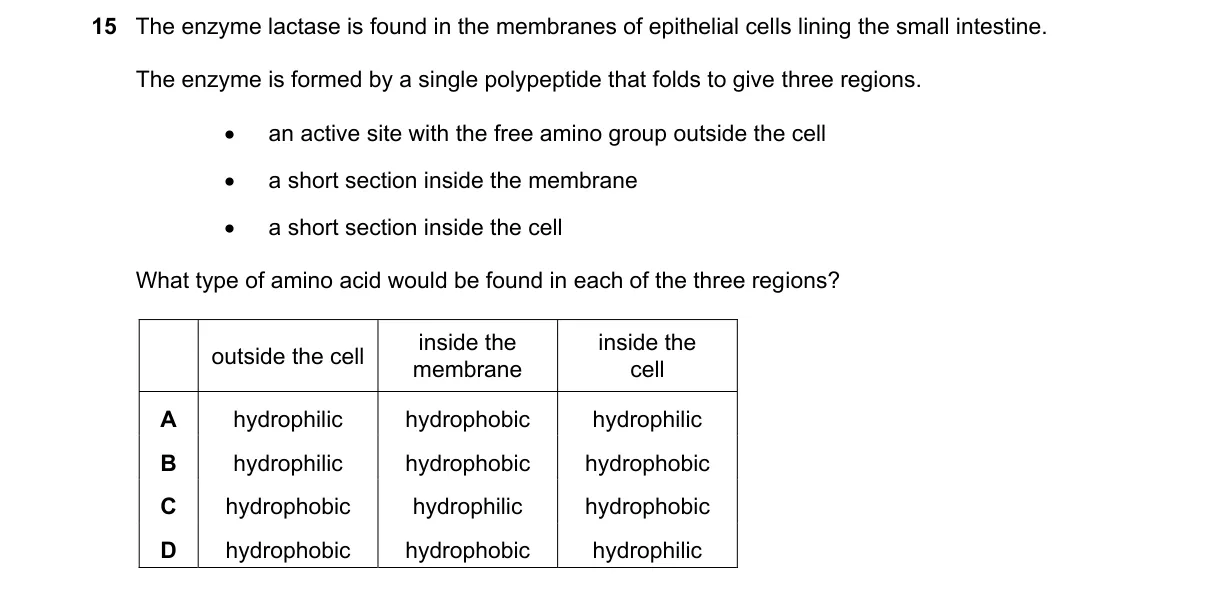
Answer choices
- Ahydrophilic (outside the cell), hydrophobic (inside the membrane), hydrophilic (inside the cell)
- Bhydrophobic (outside the cell), hydrophilic (inside the membrane), hydrophobic (inside the cell)
- Chydrophobic (outside the cell), hydrophilic (inside the membrane), hydrophobic (inside the cell)
- Dhydrophobic (outside the cell), hydrophobic (inside the membrane), hydrophilic (inside the cell)
Explanation
Membrane Protein Solubility
Steps:
- Identify regions: outside cell (aqueous), membrane (lipid bilayer), inside cell (aqueous).
- Recall amino acids interact with environments: hydrophilic in water, hydrophobic in lipids.
- Active site outside requires hydrophilic amino acids for solubility and function in watery lumen.
- Membrane-spanning section needs hydrophobic amino acids to embed in fatty tails.
- Cytoplasmic side faces watery interior, so hydrophilic amino acids there.
Why A is correct:
- Matches principle that membrane proteins have hydrophilic domains in aqueous compartments and hydrophobic in the nonpolar membrane core.
Why the others are wrong:
- B: Wrongly places hydrophobic outside, ignoring aqueous exposure.
- C: Identical to B, so same error in external hydrophobicity.
- D: Fails to make membrane section hydrophobic, preventing stable embedding.
Final answer: A
Topic: Fluid mosaic membranes
Practice more A Levels Biology (9700) questions on mMCQ.me