A Levels Biology (9700)•9700/13/M/J/20
A Levels Biology (9700) — 9700/13/M/J/20, Question 9
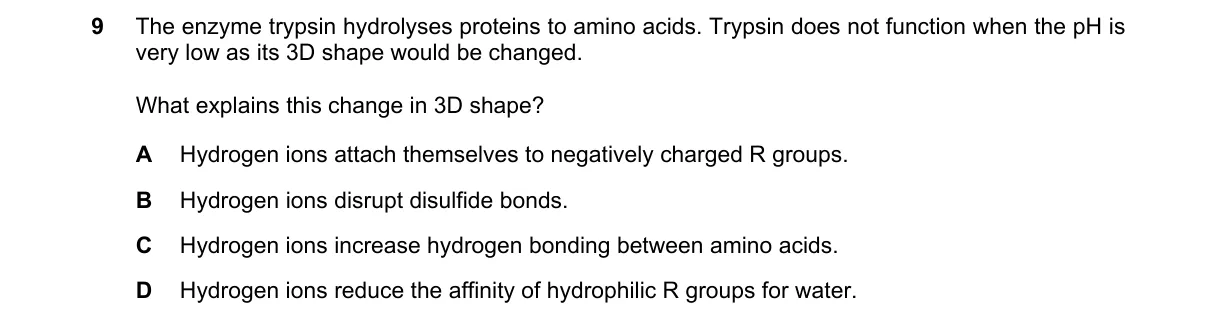
The enzyme trypsin hydrolyses proteins into amino acids. Trypsin does not function when the pH is very low as its 3D shape would be changed. What explains this change in 3D shape?
Answer choices
- AHydrogen ions attach to negatively charged R groups.
- BHydrogen ions disrupt disulfide bonds.
- CHydrogen ions increase hydrogen bonding between amino acids.
- DHydrogen ions reduce the affinity of hydrophilic groups for water.
Explanation
Enzyme Denaturation by Low pH
Steps:
- Low pH increases H+ concentration, altering the charge balance in protein side chains.
- Negatively charged R groups (like carboxylate) protonate, gaining positive charges.
- This charge repulsion disrupts ionic bonds and hydrogen bonds maintaining 3D shape.
- Resulting structural change denatures the enzyme, impairing function.
Why A is correct:
- Protonation of negatively charged R groups (e.g., -COO- to -COOH) introduces repulsive forces, per principles of electrostatic interactions in protein folding.
Why the others are wrong:
- B: Disulfide bonds are covalent and unaffected by pH; they require reducing agents to break.
- C: Low pH decreases, not increases, hydrogen bonding by protonating potential donors/acceptors.
- D: Hydrophilic groups' water affinity changes minimally; denaturation stems from charge disruption, not hydrophilicity.
Final answer: A
Topic: Factors that affect enzyme action
Practice more A Levels Biology (9700) questions on mMCQ.me