A Levels Biology (9700)•9700/13/M/J/20
A Levels Biology (9700) — 9700/13/M/J/20, Question 6
Samples of fruit juice were tested for the presence of reducing sugar and non-reducing sugars using hydrolysis, boiling with Benedict's solution after acid hydrolysis and boiling with Benedict's solution. The colour of positive Benedict's test is due to formation of copper oxide. Mass of copper oxide is proportional to the mass of reducing sugar formed. Samples of fruit juice were tested for the presence of reducing sugars and non-reducing sugars. Hydrolysis shows the mass of copper oxide after boiling with Benedict's solution and after acid hydrolysis and boiling with Benedict's solution. Which sample contained the most non-reducing sugar? The table shows: after boiling with Benedict's solution and after acid hydrolysis and boiling with Benedict's solution.
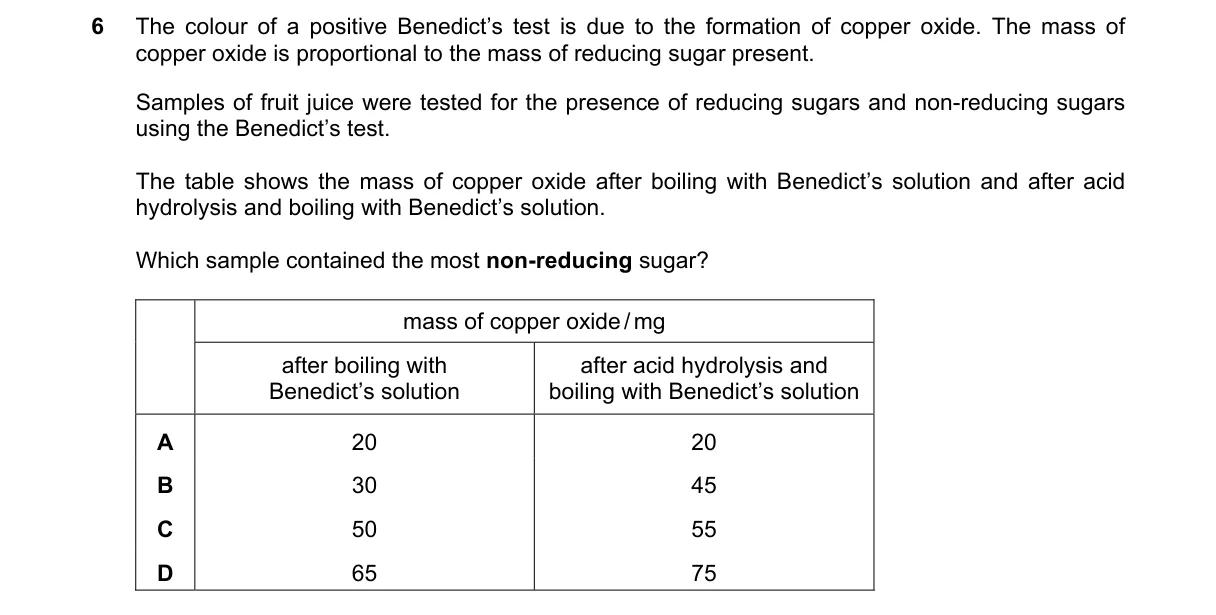
Answer choices
- A20, 20
- B30, 45
- C50, 55
- D65, 75
Explanation
Difference in copper oxide mass indicates non-reducing sugar
Steps:
- Mass after direct Benedict's test measures reducing sugar.
- Mass after hydrolysis and Benedict's test measures total sugar (reducing + non-reducing).
- Non-reducing sugar = total mass - reducing mass.
- Compare differences: A (20-20=0), B (45-30=15), C (55-50=5), D (75-65=10).
Why B is correct:
- Largest difference (15) shows most non-reducing sugar hydrolyzed to reducing form.
Why the others are wrong:
- A: Zero difference means no non-reducing sugar.
- C: Small difference (5) means less non-reducing sugar than B.
- D: Difference (10) is less than B's 15.
Final answer: B
Topic: Testing for biological molecules
Practice more A Levels Biology (9700) questions on mMCQ.me