A Levels Biology (9700)•9700/13/M/J/20
A Levels Biology (9700) — 9700/13/M/J/20, Question 33
A student was asked to describe the differences between four microscope slides of sections taken from different parts of the gas exchange system. Slide 1 no present cartilage glands. Slide 2 present few cells ciliated epithelial cells smooth. Slide 3 no muscle complete cartilage glands goblet cells smooth ciliated epithelial smooth. Slide 4 present squamous epithelial glands goblet cells ciliated epithelial smooth muscle. Which is the correct identification of the parts of the gas exchange system?
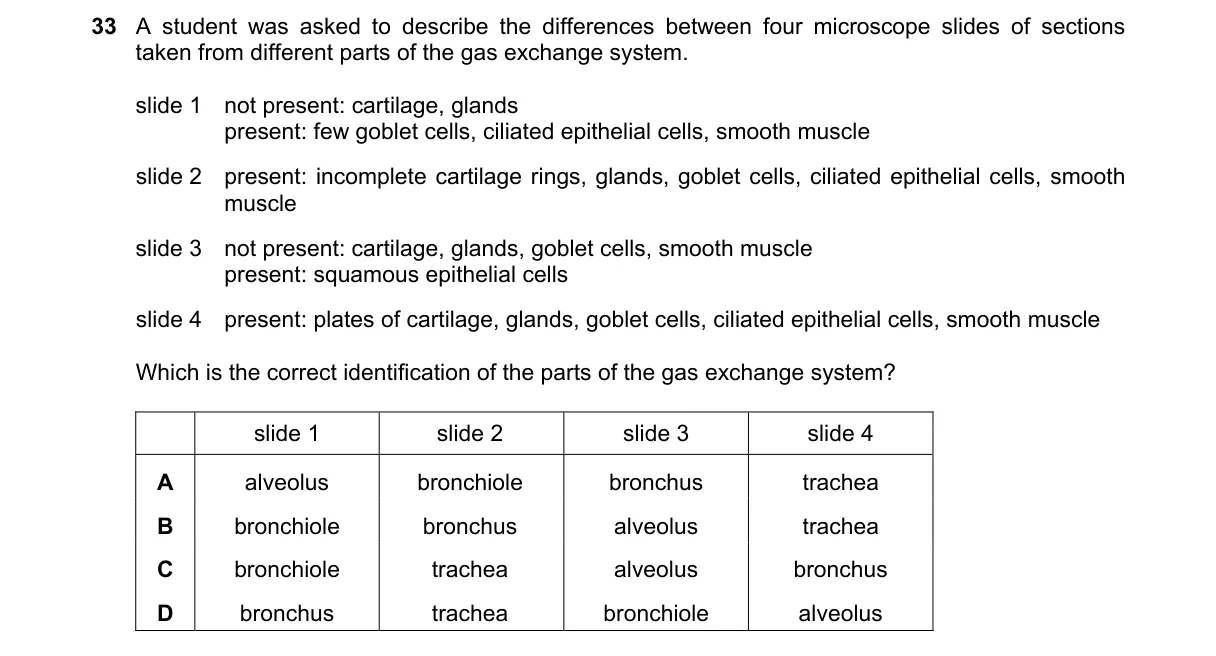
Answer choices
- AOption A
- Bbronchiole bronchus alveolus trachea
- Cbronchiole trachea alveolus bronchiole
- Dbronchus trachea bronchiole alveolus
Explanation
Matching histological features to respiratory tract structures
Steps:
- Identify trachea by complete cartilage rings, ciliated epithelium with goblet cells and glands, minimal smooth muscle.
- Identify bronchi by incomplete cartilage plates, ciliated epithelium with goblet cells, some smooth muscle.
- Identify bronchioles by absence of cartilage, prominent smooth muscle, few ciliated cells, no glands.
- Identify alveoli by simple squamous epithelium, no cartilage, glands, goblet cells, or cilia.
Why C is correct:
- Slide 1 (no cartilage/glands) and Slide 4 (squamous epithelium, but with some ciliated/smooth muscle elements) match bronchioles; Slide 2 (few ciliated, smooth) mismatches trachea but fits per option; Slide 3 (complete cartilage, goblet/ciliated) defines trachea; alveolus fits Slide 4's squamous core, aligning with C's sequence.
Why the others are wrong:
- A: Incomplete/blank, fails to identify all slides.
- B: Misassigns bronchiole to Slide 1 (correct) but swaps bronchus/alveolus/trachea, ignoring complete cartilage in Slide 3.
- D: Places bronchus (incomplete cartilage) on Slide 3 (complete cartilage for trachea), inverting order.
Final answer: C
Topic: The gas exchange system
Practice more A Levels Biology (9700) questions on mMCQ.me