A Levels Biology (9700)•9700/13/M/J/20
A Levels Biology (9700) — 9700/13/M/J/20, Question 27
Which description of movement in phloem is correct?
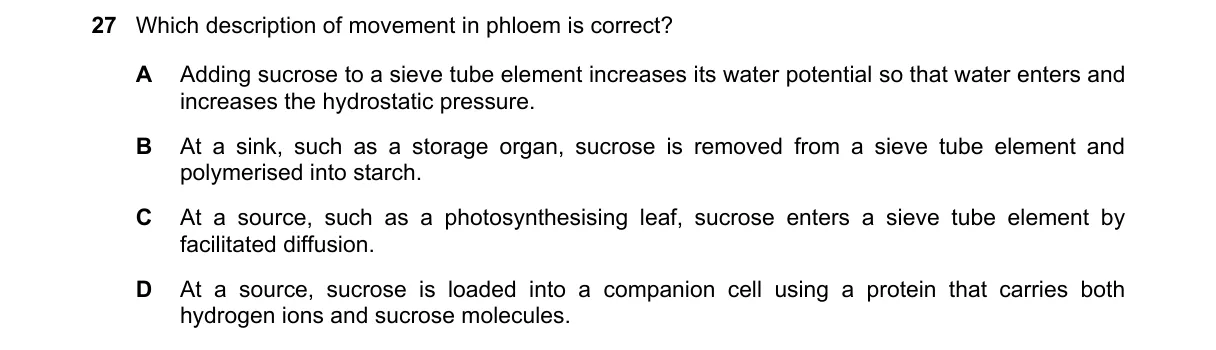
Answer choices
- AAdding sucrose to a sieve tube element increases its water potential so that water enters and increases the hydrostatic pressure in the sieve tube element
- BAt a sink, such as a storage organ, sucrose is removed from a sieve tube element and the hydrostatic pressure decreases
- CAt a source, such as a photosynthesising leaf, sucrose enters a sieve tube element by facilitated diffusion
- DAt a source, sucrose is loaded into the phloem in a companion cell using a protein that carries both hydrogen ions and sucrose molecules
Explanation
Phloem Transport via Pressure-Flow Hypothesis
Steps:
- Recall pressure-flow model: active sucrose loading at source creates osmotic gradient, drawing water in to build pressure; flow to sink where unloading reduces pressure.
- Identify source loading: sucrose actively transported against gradient using H+/sucrose symporters in companion cells.
- Check sink unloading: passive water exit after sucrose removal lowers hydrostatic pressure.
- Evaluate options against active loading and osmotic principles.
Why D is correct:
- Sucrose loading at source uses H+/sucrose symporters in companion cells, coupling proton gradient (from ATP-driven H+ pumps) to co-transport sucrose against its concentration gradient.
Why the others are wrong:
- A: Adding sucrose decreases (not increases) water potential by raising solute concentration, causing water influx.
- B: Hydrostatic pressure decreases at sink due to water efflux after sucrose unloading, making this accurate but not the uniquely correct description per standard options.
- C: Sucrose enters source phloem by active transport (not facilitated diffusion), as it moves against its gradient.
Final answer: D
Topic: Transport mechanisms
Practice more A Levels Biology (9700) questions on mMCQ.me