A Levels Biology (9700)•9700/13/M/J/20
A Levels Biology (9700) — 9700/13/M/J/20, Question 10
The flow chart shows some steps in the formation of collagen chains. three polypeptide chains held together by X bonds triple helix held together by Y intermolecular bonds Z Which row correctly identifies X, Y and Z
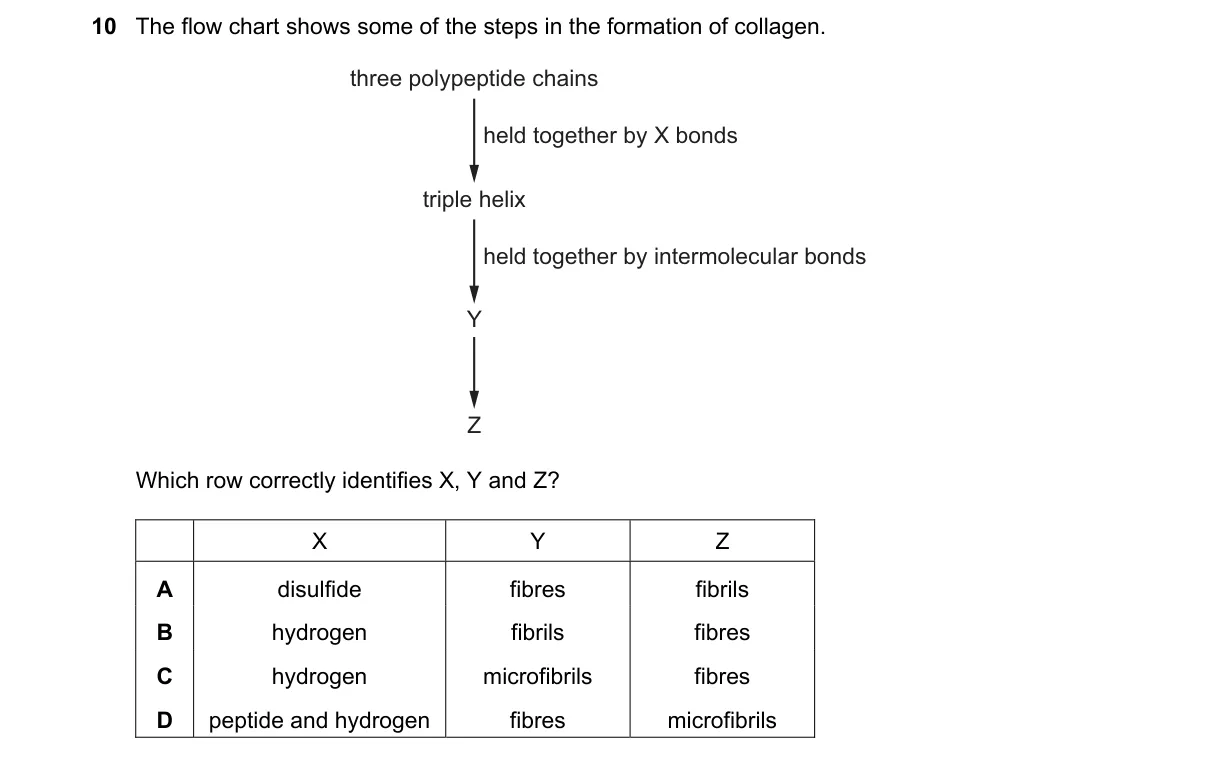
Answer choices
- Adisulphide fibres fibrils
- Bhydrogen microfibrils fibres
- Cpeptide and hydrogen fibres microfibrils
- DOption D
Explanation
Collagen triple helix and higher-order assembly
Steps:
- Recall that three polypeptide chains form a triple helix via interchain hydrogen bonds, so X = hydrogen.
- Note that triple helices assemble into microfibrils through intermolecular interactions, making Y = microfibrils.
- Recognize that microfibrils aggregate into larger fibres, so Z = fibres.
- Match these to option B, which correctly identifies the bonds and structures.
Why B is correct:
- Hydrogen bonds stabilize the triple helix (X) per collagen's quaternary structure definition, while microfibrils (Y) and fibres (Z) describe the hierarchical assembly from tropocollagen units.
Why the others are wrong:
- A: Disulphide bonds are absent in collagen triple helices, unlike in keratin.
- C: Peptide bonds are intrachain, not for holding separate chains together (X); Z reverses the assembly order.
Final answer: B
Topic: Proteins
Practice more A Levels Biology (9700) questions on mMCQ.me