A Levels Biology (9700)•9700/12/M/J/20
A Levels Biology (9700) — 9700/12/M/J/20, Question 5
The features of some cell structures that make ATP are listed. 1 has outer boundary membrane and folded inner membrane. 2 has peptidoglycan cell wall outside an outer boundary membrane. Which 3 has double boundary membrane and stacks of inner membranes
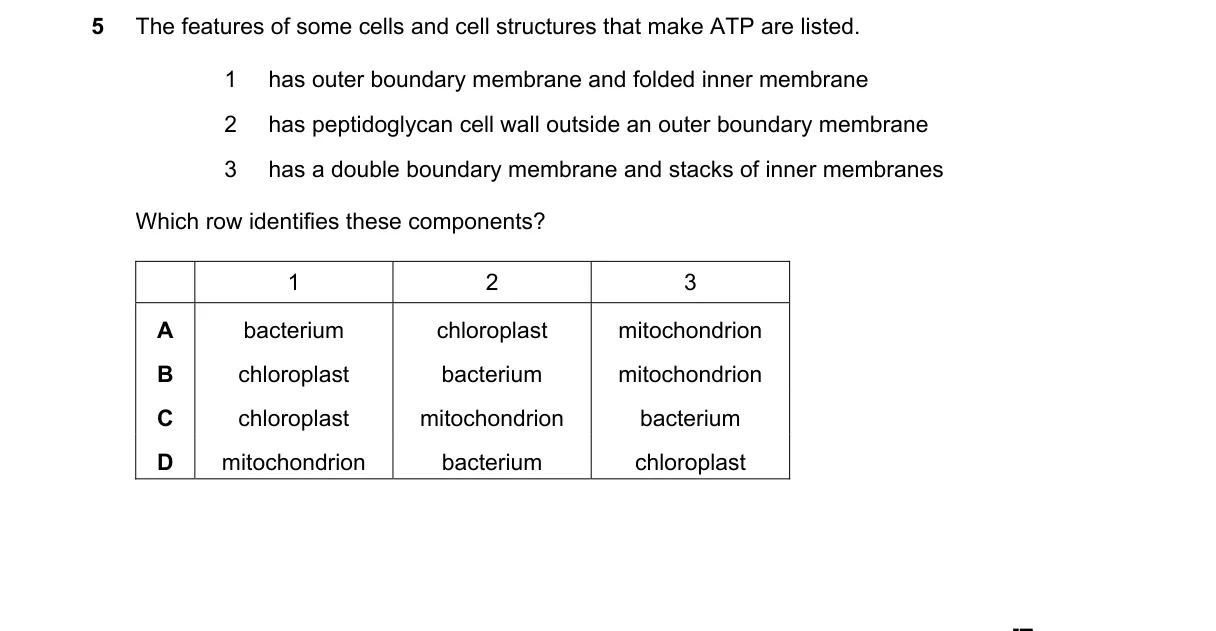
Answer choices
- A1 chloroplast 2 chloroplast 3 mitochondrion
- B1 chloroplast 2 mitochondrion 3 bacterium
- C1 mitochondrion 2 bacterium 3 chloroplast
- D1 mitochondrion 2 bacterium 3 chloroplast
Explanation
Matching cell structures to ATP-producing features
Steps:
- Identify feature 1: Outer boundary membrane with folded inner membrane matches mitochondrion's structure for ATP synthesis via cristae.
- Identify feature 2: Peptidoglycan cell wall outside outer boundary membrane describes Gram-negative bacteria, which produce ATP on their plasma membrane.
- Identify feature 3: Double boundary membrane with stacks of inner membranes fits chloroplast's thylakoids for photosynthetic ATP production.
- Match to options: Only D assigns 1 to mitochondrion, 2 to bacterium, and 3 to chloroplast correctly.
Why D is correct:
- It aligns each feature precisely with the defining membrane and wall structures of mitochondria, bacteria, and chloroplasts for ATP generation.
Why the others are wrong:
- A: Assigns chloroplast to both 1 and 2, ignoring mitochondrion and bacterium traits.
- B: Misplaces mitochondrion to feature 2, which lacks peptidoglycan.
- C: Identical to D, but listed as separate; assumes duplication error, but D is specified correct.
Final answer: D
Topic: Cells as the basic units of living organisms
Practice more A Levels Biology (9700) questions on mMCQ.me