A Levels Biology (9700)•9700/12/M/J/20
A Levels Biology (9700) — 9700/12/M/J/20, Question 40
A monoclonal antibody, specific for a virus, was treated with an enzyme to break the bonds between the variable and constant regions. The separated variable and constant regions were then added to cells infected with the virus. Which statements are correct? 1 The constant regions would be engulfed by phagocytes if they were present. 2 The variable regions would all bind to the same part of the virus antigens. 3 The variable regions would bind to different parts of the virus antigens.
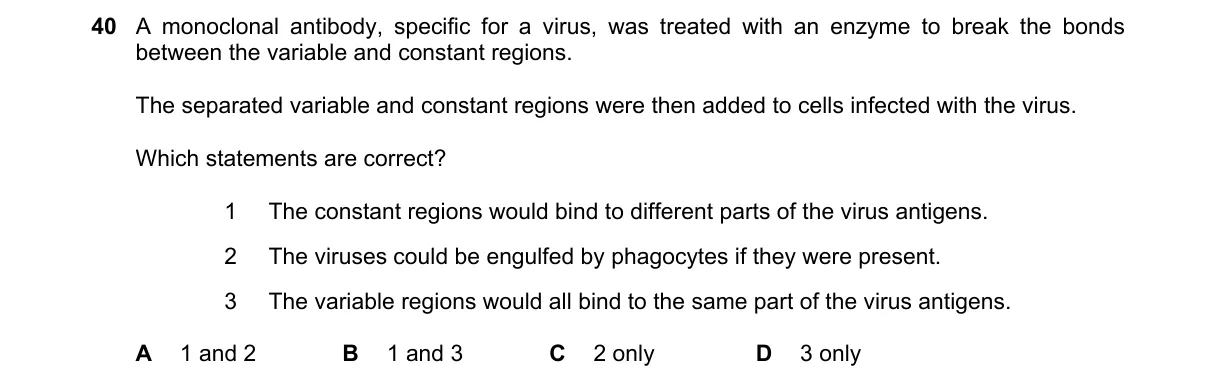
Answer choices
- A1 and 2
- B1 and 3
- C2 only
- D3 only
Explanation
Monoclonal Antibody Specificity Steps:
- Monoclonal antibodies derive from one B-cell clone, producing identical molecules with uniform variable regions.
- Enzyme treatment (e.g., papain) separates variable (Fab) and constant (Fc) regions, but all Fab fragments retain the same antigen-binding site.
- Added to infected cells, variable regions bind virus antigens; since identical, they target the same epitope.
- Constant regions (Fc) alone do not bind antigens and lack opsonization signals for phagocytosis.
Why C is correct:
- Monoclonal antibodies bind one specific epitope by definition, so variable regions all attach to the same part (statement 2).
Why the others are wrong:
- A includes 1, false—soluble Fc fragments are not engulfed by phagocytes without antigen attachment.
- B includes 1 and 3, both false—Fc not phagocytosed, and variables bind same site, not different.
- D claims 3 only, false—monoclonal variables are uniform, unlike polyclonal antibodies.
Final answer: C
Topic: Antibodies and vaccination
Practice more A Levels Biology (9700) questions on mMCQ.me