A Levels Biology (9700)•9700/12/M/J/20
A Levels Biology (9700) — 9700/12/M/J/20, Question 39
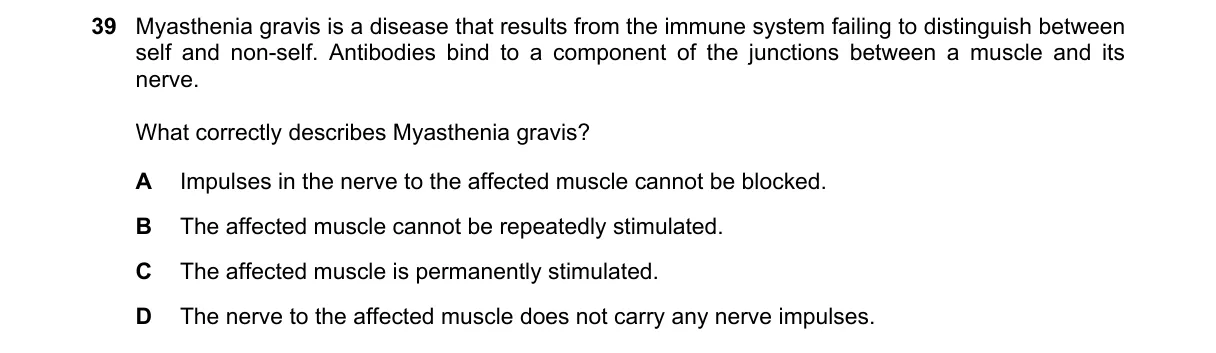
Myasthenia gravis is a disease that results from the immune system failing to distinguish between self and non-self. Antibodies bind to a component of the junctions between a muscle and its nerve. What correctly describes Myasthenia gravis?
Answer choices
- AThe affected muscle cannot be blocked.
- BThe affected muscle cannot be repeatedly stimulated.
- CThe affected muscle permanently stimulates.
- DThe nerve to the affected muscle does not carry any impulses.
Explanation
Autoimmune disruption of neuromuscular transmission
Steps:
- Myasthenia gravis involves autoantibodies targeting acetylcholine receptors at the neuromuscular junction.
- These antibodies block or degrade receptors, reducing acetylcholine binding.
- Initial muscle contractions occur, but repeated stimulation depletes available receptors, causing fatigue.
- This impairs sustained muscle activation without affecting nerve impulse generation.
Why B is correct:
- Autoantibodies limit receptor availability, preventing effective repeated stimulation as defined by neuromuscular transmission failure in autoimmune disorders.
Why the others are wrong:
- A: Muscles are blocked due to impaired transmission, not inability to block.
- C: No permanent stimulation; instead, muscles weaken and fatigue.
- D: Nerves carry impulses normally; the issue is at the junction.
Final answer: B
Topic: The immune system
Practice more A Levels Biology (9700) questions on mMCQ.me