A Levels Biology (9700)•9700/12/M/J/20
A Levels Biology (9700) — 9700/12/M/J/20, Question 37
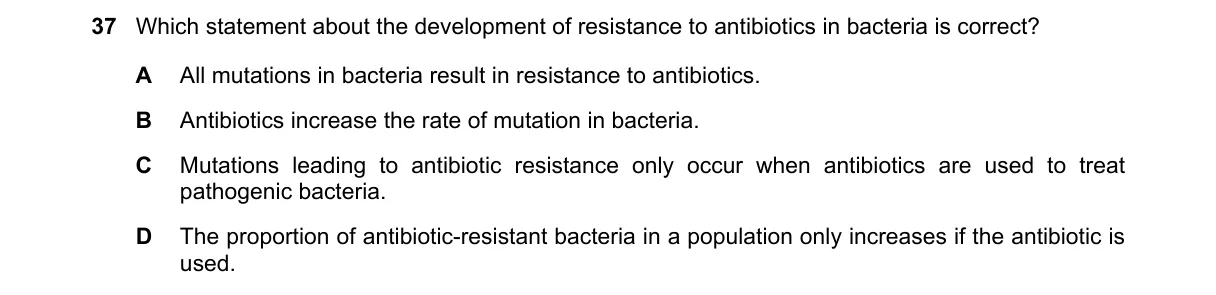
Which statement about the development of resistance to antibiotics in bacteria is correct?
Answer choices
- AAll mutations in bacteria result in resistance to antibiotics.
- BAntibiotics increase the rate of mutation in bacteria.
- CMutations leading to antibiotic resistance only occur when antibiotics are used to treat pathogenic bacteria.
- DThe proportion of antibiotic-resistant bacteria in a population only increases if the antibiotic is used.
Explanation
Natural Selection Drives Antibiotic Resistance
Steps:
- Mutations arise randomly in bacterial populations, independent of antibiotics.
- Most mutations are neutral or harmful; only rare ones confer resistance.
- Antibiotics kill susceptible bacteria, allowing resistant ones to survive and reproduce.
- Over generations, the proportion of resistant bacteria increases only under antibiotic pressure.
Why D is correct:
- Natural selection favors resistant bacteria when antibiotics are present, increasing their relative proportion in the population (Darwin's theory of evolution by natural selection).
Why the others are wrong:
- A: Mutations are random and rarely lead to resistance; most do not.
- B: Antibiotics select for pre-existing resistant mutants but do not increase mutation rates.
- C: Mutations occur spontaneously at all times, not just during antibiotic treatment.
Final answer: D
Topic: Antibiotics
Practice more A Levels Biology (9700) questions on mMCQ.me