A Levels Biology (9700)•9700/12/M/J/20
A Levels Biology (9700) — 9700/12/M/J/20, Question 31
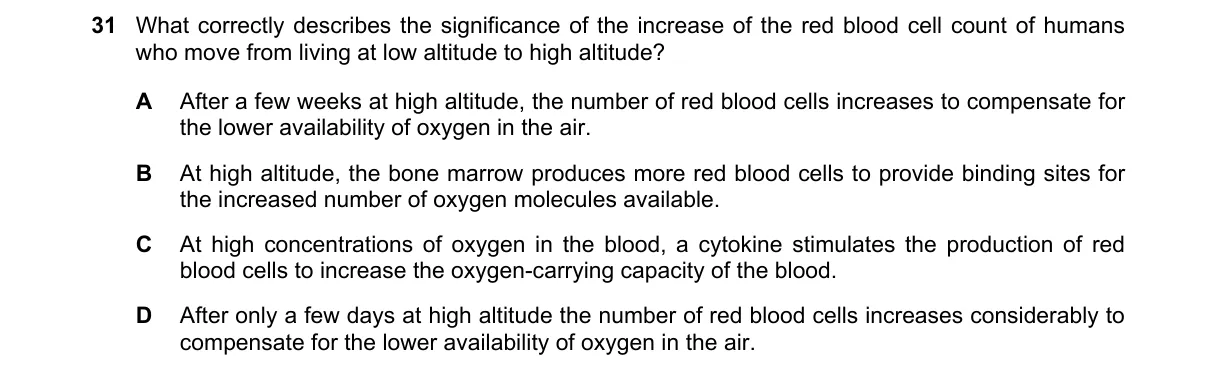
What correctly describes the significance of the increase of red blood cells of humans who move from living at low altitude to high altitude
Answer choices
- AAfter a few weeks at high altitude, the number of red blood cells increases to compensate for the lower availability of oxygen in the air.
- BAt high altitude, the bone marrow produces more red blood cells to provide binding sites for oxygen molecules.
- CAt high concentrations of oxygen molecules in the blood, erythropoietin stimulates the production of red blood cells.
- DAfter only a few days at high altitude, the oxygen-carrying capacity of the blood increases considerably.
Explanation
High-altitude acclimatization via erythropoiesis
Steps:
- Recognize that high altitude reduces atmospheric oxygen, causing hypoxia.
- Recall that kidneys detect low blood oxygen and release erythropoietin (EPO) to stimulate red blood cell production.
- Note the process takes weeks for significant red blood cell increase.
- Evaluate options against this timeline and mechanism to select A.
Why A is correct:
- It accurately describes acclimatization, where EPO triggers bone marrow to boost red blood cell count over weeks, enhancing oxygen transport per the physiological response to hypoxia.
Why the others are wrong:
- B: Bone marrow does produce more cells, but the trigger is low oxygen, not just providing binding sites.
- C: EPO stimulates at low, not high, blood oxygen concentrations.
- D: Oxygen capacity increases gradually over weeks, not considerably in days.
Final answer: A
Topic: Transport of oxygen and carbon dioxide
Practice more A Levels Biology (9700) questions on mMCQ.me