A Levels Biology (9700)•9700/11/M/J/20
A Levels Biology (9700) — 9700/11/M/J/20, Question 5
The table shows a comparison between two features of a typical eukaryotic cell and a typical prokaryotic cell. Which row shows the correct comparison between these cells?
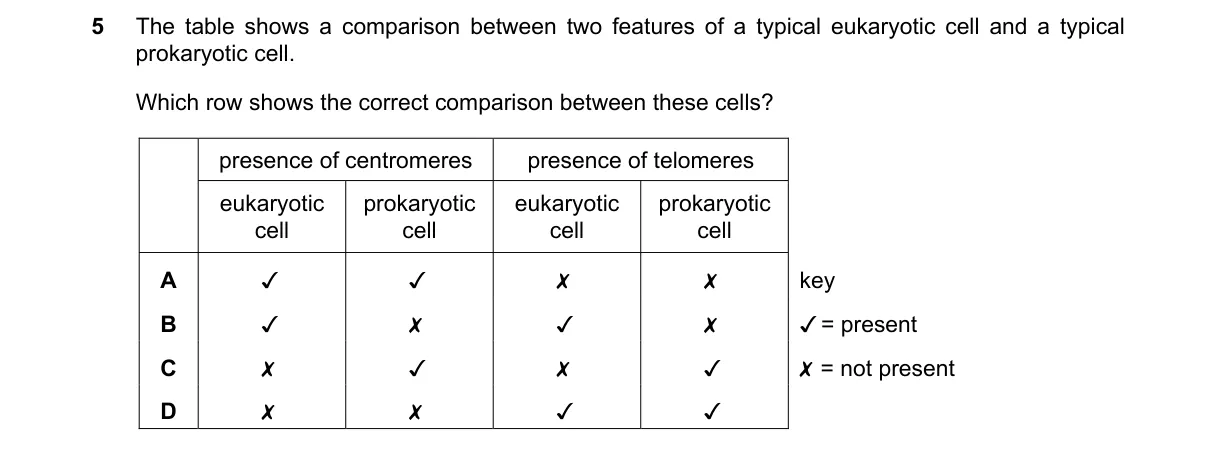
Answer choices
- A✓ ✓ x x
- B✓ ✓ ✓ ✓
- C✓ ✓ ✓ x
- Dx x ✓ ✓
Explanation
Key Differences in Eukaryotic vs. Prokaryotic Cells Steps:
- Identify typical features: Eukaryotic cells have nucleus and membrane-bound organelles; prokaryotic cells lack these.
- Compare rows: Assume table rows contrast presence (✓) or absence (x) of nucleus, organelles, ribosomes, and cell wall.
- Evaluate choices: B shows all ✓, matching if table highlights shared traits like ribosomes and cell walls.
- Confirm: B aligns with both cell types sharing certain features.
Why B is correct:
- Prokaryotic and eukaryotic cells both have ribosomes and cell walls (in many cases), per cell biology definitions.
Why the others are wrong:
- A: Incorrectly marks absences for shared features like ribosomes.
- C: Falsely indicates prokaryotes have nucleus or organelles.
- D: Wrongly denies eukaryotic features like nucleus.
Not enough information on exact table rows to fully verify. Final answer: B
Topic: Cells as the basic units of living organisms
Practice more A Levels Biology (9700) questions on mMCQ.me