A Levels Biology (9700)•9700/11/M/J/20
A Levels Biology (9700) — 9700/11/M/J/20, Question 38
The antibiotic teixobactin was discovered in January 2015. Teixobactin kills some bacteria such as Staphylococcus and Mycobacterium. Most antibiotics work by binding to proteins. This means that it is likely that bacteria will quickly develop resistance to teixobactin. Which statements explain why bacteria are unlikely to quickly develop resistance to teixobactin? 1 A mutation in the gene coding for a protein allows selection for resistance. 2 Teixobactin binds to lipid rather than a protein. 3 The structure of lipid is not coded by DNA.
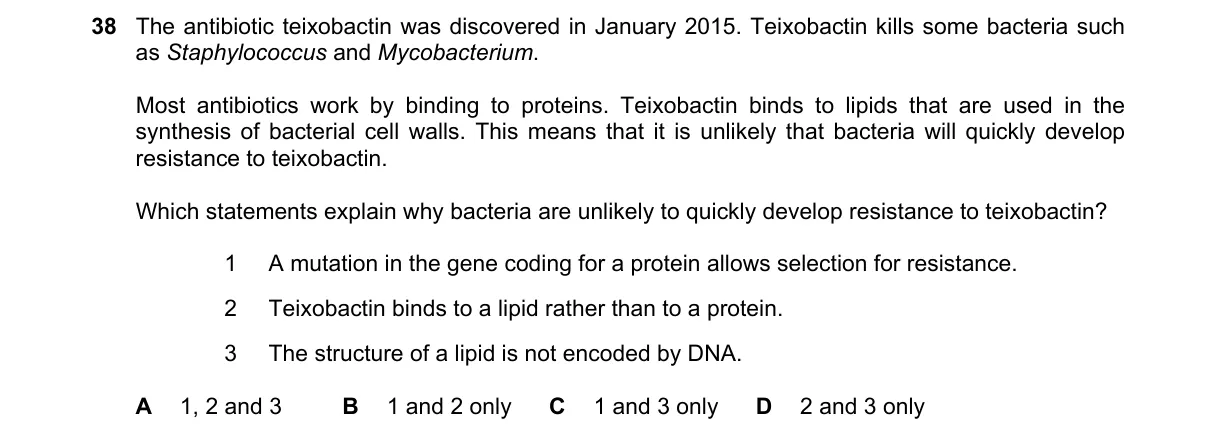
Answer choices
- A1, 2 and 3
- B1 and 2 only
- C2 and 3 only
- D3 only
Explanation
Lipid targeting prevents easy mutational resistance
Steps:
- Antibiotics binding proteins enable resistance via DNA mutations altering protein structure.
- Teixobactin targets lipids, not proteins, avoiding protein mutation pathways.
- Lipid structures form through biochemical pathways, not direct DNA coding.
- Without DNA-coded targets, random mutations rarely confer resistance to lipid-binding antibiotics.
Why D is correct:
- Statement 3 states lipid structure is not DNA-coded, directly explaining low resistance risk per evolutionary biology, as mutations cannot easily modify non-genetic targets.
Why the others are wrong:
- A includes 1, which describes protein-based resistance mechanism, contradicting unlikelihood for teixobactin.
- B includes 1, which promotes resistance development, not prevention.
- C includes 2, a factual difference but not explanatory without 3's genetic rationale.
Final answer: D
Topic: Antibiotics
Practice more A Levels Biology (9700) questions on mMCQ.me