A Levels Biology (9700)•9700/11/M/J/20
A Levels Biology (9700) — 9700/11/M/J/20, Question 37
Which factors would increase global distribution of malaria? 1 an increase in global temperatures 2 an increase in the use of antibiotics 3 a rise in irrigation for farming 4 a fall in annual rainfall
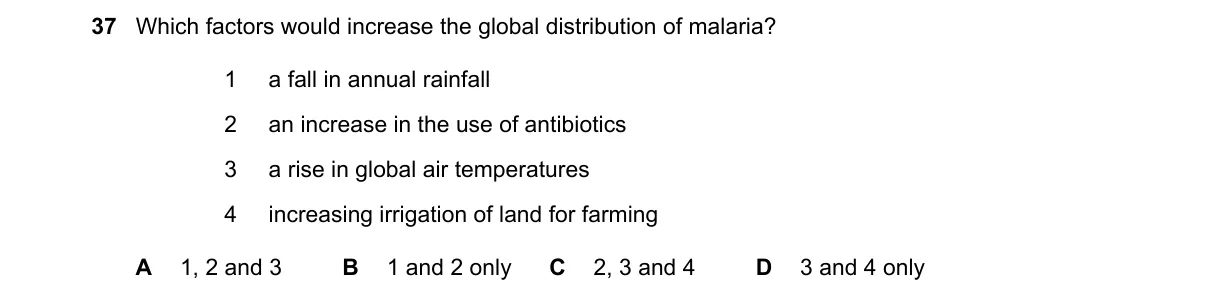
Answer choices
- A1,2 and 3
- B1 and 2 only
- C2 and 4
- D3 and 4 only
Explanation
Factors Affecting Malaria Distribution via Mosquito Breeding Conditions
Steps:
- Identify that malaria spreads through Anopheles mosquitoes, which require warm temperatures and standing water to breed and expand geographically.
- Assess factor 1: Higher global temperatures enable mosquitoes to survive in cooler regions previously unsuitable, broadening their range.
- Assess factor 3: Increased irrigation creates more stagnant water pools in fields, boosting mosquito breeding sites and local transmission, aiding global spread.
- Assess factors 2 and 4: Antibiotics target bacteria, not malaria parasites or mosquitoes; reduced rainfall limits water availability, shrinking breeding areas.
Why 1 and 3 increase distribution:
- Mosquito life cycle accelerates in warmer conditions (optimal 20–30°C per entomology studies), and irrigation adds essential breeding habitats.
Why the options are wrong:
- A includes irrelevant factor 2.
- B omits key factor 3 and includes irrelevant 2.
- C and D include factors 2 and 4 that do not promote spread.
Final answer: None (correct factors are 1 and 3)
Topic: Infectious diseases
Practice more A Levels Biology (9700) questions on mMCQ.me