A Levels Biology (9700)•9700/11/M/J/20
A Levels Biology (9700) — 9700/11/M/J/20, Question 29
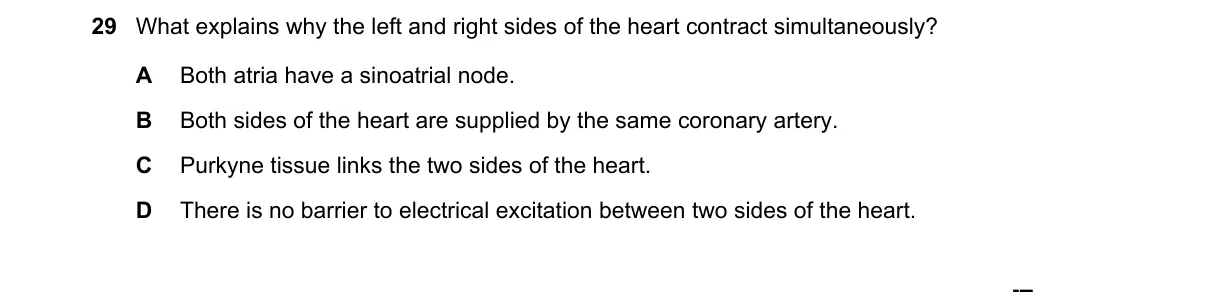
What explains why the left and right sides of the heart contract simultaneously?
Answer choices
- ABoth atria have a sinoatrial node
- BBoth sides of the heart are supplied by the same coronary artery.
- CPurkyne tissue links the two sides of the heart
- DThere is no barrier to electrical excitation between two sides of the heart.
Explanation
Electrical conduction synchronizes heart contractions
Steps:
- The heart's electrical impulse starts at the sinoatrial node in the right atrium.
- It spreads through both atria, causing them to contract together.
- The impulse reaches the atrioventricular node, then travels via bundle of His and Purkinje fibers to both ventricles.
- No insulating barrier exists between left and right sides, allowing simultaneous ventricular excitation and contraction.
Why D is correct:
- The cardiac conduction system lacks a barrier between sides, enabling electrical impulses to propagate uniformly from atria to ventricles on both left and right, per the physiology of action potential spread in myocardial tissue.
Why the others are wrong:
- A: Only the right atrium has a sinoatrial node; the left does not.
- B: Coronary arteries supply blood, not electrical signals; sides have separate arteries.
- C: Purkinje fibers conduct within ventricles but do not directly link left and right sides across the septum.
Final answer: D
Topic: The heart
Practice more A Levels Biology (9700) questions on mMCQ.me