A Levels Biology (9700)•9700/11/M/J/20
A Levels Biology (9700) — 9700/11/M/J/20, Question 28
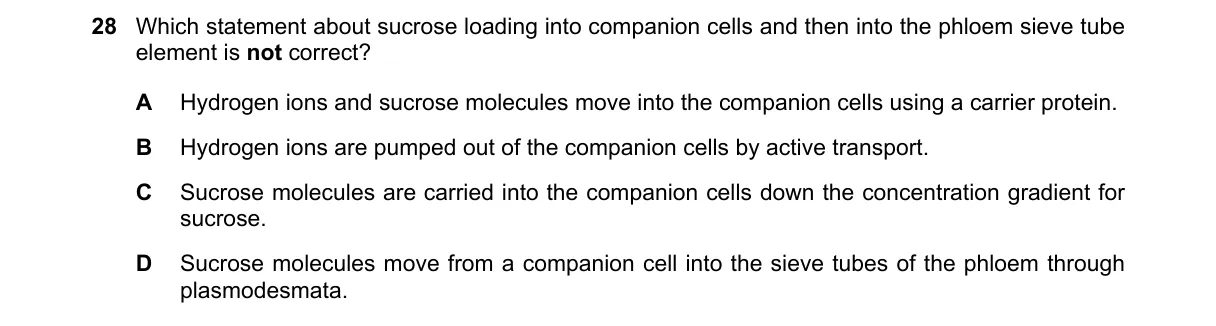
Which statement about sucrose loading into companion cells and into the phloem sieve tube is not correct?
Answer choices
- AHydrogen ions are pumped out of the companion cells by active transport using a carrier protein.
- BSucrose molecules are carried into the companion cells down the concentration gradient for
- CSucrose molecules are carried into the companion cells down the concentration gradient for sucrose molecules.
- DSucrose molecules move from a companion cell into the sieve tubes of the phloem through plasmodesmata.
Explanation
Phloem Sucrose Loading Mechanism
Steps:
- Proton pumps actively export H+ from companion cells, creating an electrochemical gradient.
- Sucrose enters companion cells via H+/sucrose symporters, moving against its concentration gradient.
- Inside companion cells, sucrose concentration rises above that in mesophyll, enabling mass flow.
- Sucrose diffuses symplastically into sieve tubes via plasmodesmata.
Why C is correct:
- Sucrose uptake into companion cells occurs against its concentration gradient via secondary active transport, not down it.
Why the others are wrong:
- A: Proton pumps use ATP to actively transport H+ out, correctly described.
- B: Sucrose entry follows the H+ gradient (facilitated diffusion for protons), but the statement aligns with symport mechanics.
- D: Companion cells connect to sieve tubes via plasmodesmata for symplastic sucrose transfer.
Final answer: C
Topic: Transport mechanisms
Practice more A Levels Biology (9700) questions on mMCQ.me