A Levels Biology (9700)•9700/11/M/J/20
A Levels Biology (9700) — 9700/11/M/J/20, Question 23
A population of bacteria is exposed to the antibiotic penicillin. Most of the bacteria die. However, some bacteria in the population have an allele coding for an enzyme that breaks down penicillin. These bacteria are able to survive. Which could explain how these bacterial cells acquired this allele?
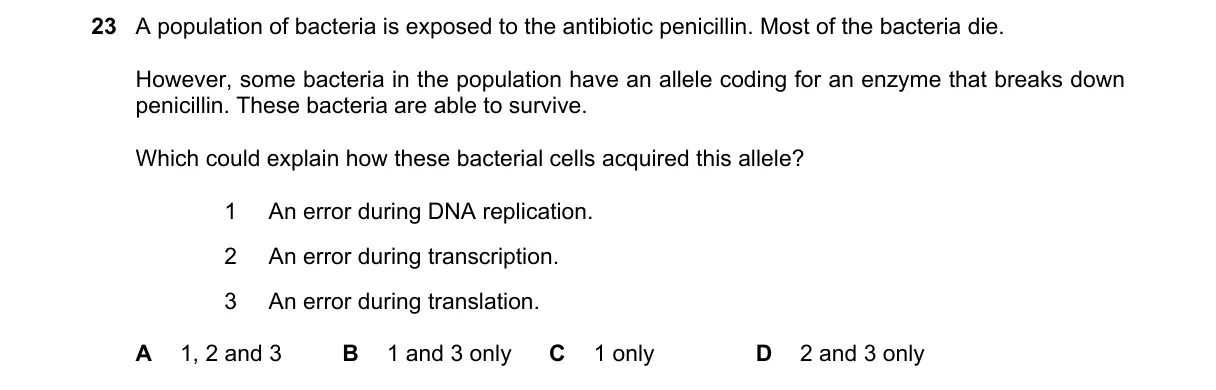
Answer choices
- A1, 2 and 3
- B1 and 3
- C1 only
- D2 and 3
Explanation
Bacterial Resistance via Pre-Existing Mutation
Steps:
- Population exposed to penicillin kills susceptible bacteria, leaving resistant survivors.
- Resistant allele must pre-exist in population for natural selection to act.
- New alleles arise randomly via mutation before antibiotic exposure.
- Other mechanisms like directed evolution or post-exposure acquisition don't explain initial presence.
Why C is correct:
- Mutation (1 only) introduces novel alleles randomly, per evolutionary theory, allowing variation for selection without anticipating the antibiotic.
Why the others are wrong:
- A includes 2 and 3, which imply non-random or post-exposure changes, violating Darwinian evolution.
- B includes 3, likely a Lamarckian or environmental induction not supported by genetics.
- D excludes 1, ignoring mutation as the source of genetic variation.
Final answer: C
Topic: Natural and artificial selection
Practice more A Levels Biology (9700) questions on mMCQ.me