A Levels Biology (9700)•9700/11/M/J/20
A Levels Biology (9700) — 9700/11/M/J/20, Question 13
An enzyme is modified for industrial use. It has a lower Michaelis-Menten constant (Km) than the unmodified enzyme. What is true of the modified enzyme?
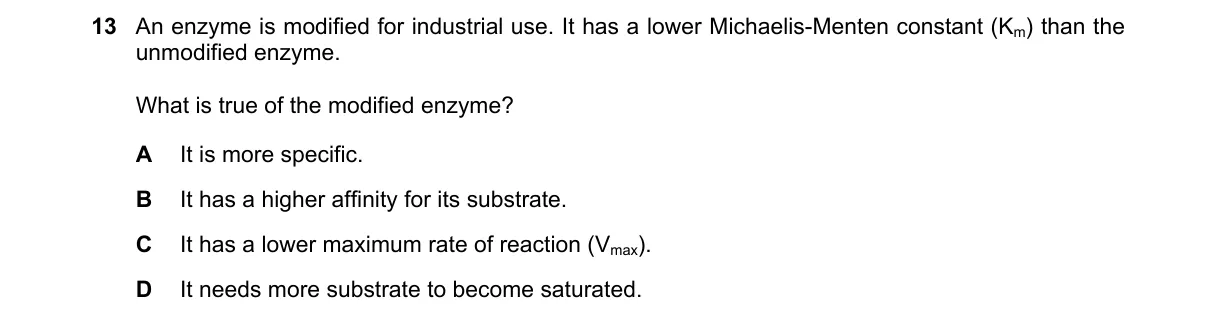
Answer choices
- AIt is more specific.
- BIt has higher affinity for its substrate.
- CIt has a lower maximum rate of reaction (Vmax).
- DIt needs less substrate to become saturated.
Explanation
Lower Km Means Higher Enzyme-Substrate Affinity
Steps:
- Km is the substrate concentration at half Vmax in Michaelis-Menten kinetics.
- A lower Km value indicates the enzyme reaches half Vmax at lower substrate levels.
- This reflects stronger binding between enzyme and substrate.
- Thus, the modified enzyme binds substrate more tightly, matching choice B.
Why B is correct:
- Km inversely measures affinity; lower Km means higher affinity per the Michaelis-Menten equation, where Km = (k_off + k_cat)/k_on.
Why the others are wrong:
- A: Specificity relates to k_cat/Km ratio, not Km alone.
- C: Vmax depends on enzyme concentration and turnover, unaffected by Km.
- D: Lower Km means saturation at lower substrate, but this restates the effect without defining the cause.
Final answer: B
Topic: Mode of action of enzymes
Practice more A Levels Biology (9700) questions on mMCQ.me