A Levels Biology (9700)•9700/13/M/J/19
A Levels Biology (9700) — 9700/13/M/J/19, Question 38
How does penicillin affect bacteria?
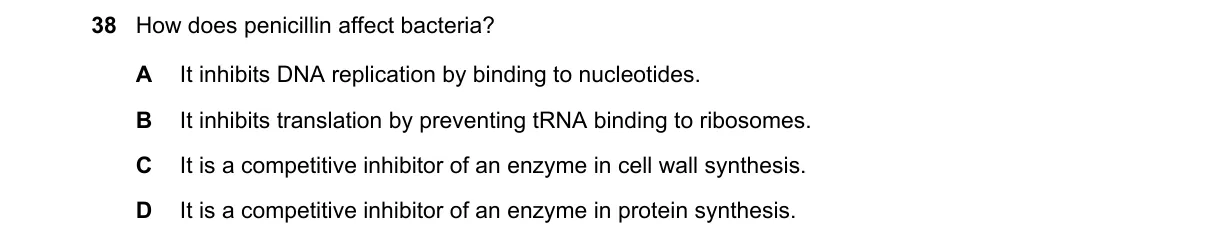
Answer choices
- AIt inhibits DNA replication by preventing tRNA binding to ribosomes
- BIt inhibits translation by preventing tRNA binding to ribosomes
- CIt is a competitive inhibitor of an enzyme in cell wall synthesis
- DIt is a competitive inhibitor of an enzyme in protein synthesis
Explanation
Penicillin Targets Bacterial Cell Wall Synthesis
Steps:
- Recall that penicillin is an antibiotic specific to bacteria with peptidoglycan cell walls.
- Identify its mechanism: binds to enzymes involved in cross-linking peptidoglycan, weakening the wall.
- Evaluate options: A and B relate to nucleic acid/protein processes, not cell walls; D misplaces the target to protein synthesis.
- Confirm C matches the inhibition of cell wall enzyme activity.
Why C is correct:
- Penicillin acts as a competitive inhibitor by binding to the active site of transpeptidase (penicillin-binding proteins), blocking peptidoglycan cross-linking essential for bacterial cell wall integrity, per the definition of competitive inhibition in enzyme kinetics.
Why the others are wrong:
- A: DNA replication inhibition (e.g., by quinolones) prevents tRNA-ribosome binding? Incorrect; that's unrelated to penicillin.
- B: Translation inhibition by blocking tRNA binding occurs with antibiotics like tetracyclines, not penicillin.
- D: Protein synthesis enzymes are targeted by drugs like streptomycin, not cell wall ones by penicillin.
Final answer: C
Topic: Antibiotics
Practice more A Levels Biology (9700) questions on mMCQ.me