A Levels Biology (9700)•9700/13/M/J/19
A Levels Biology (9700) — 9700/13/M/J/19, Question 36
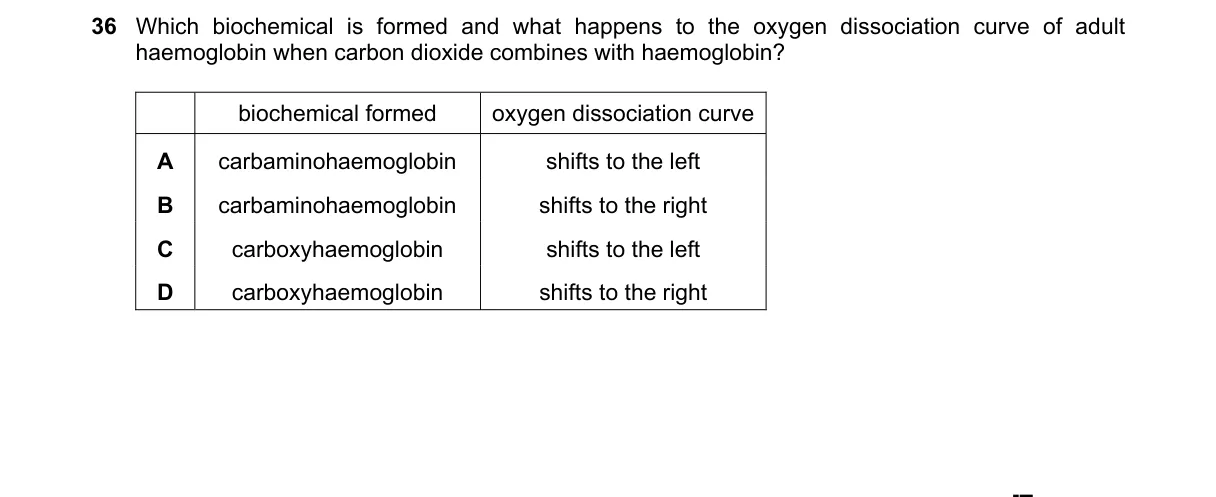
Which biochemical is formed and what happens to the oxygen dissociation curve of adult haemoglobin when carbon dioxide combines with haemoglobin?
Answer choices
- Acarbaminohemoglobin shifts to the left
- Bcarbaminohemoglobin shifts to the right
- Ccarboxyhemoglobin shifts to the right
- Dcarboxyhemoglobin shifts to the left
Explanation
CO2 Binding to Hemoglobin and Bohr Effect
Steps:
- Carbon dioxide reacts with hemoglobin's amino groups to form carbaminohemoglobin.
- Carbaminohemoglobin formation increases hemoglobin's affinity for protons (H+).
- This lowers hemoglobin's oxygen affinity via the Bohr effect.
- The oxygen dissociation curve shifts right, facilitating oxygen unloading in tissues.
Why B is correct:
- Carbaminohemoglobin contributes to the Bohr effect, defined as decreased hemoglobin oxygen affinity due to CO2 and low pH, shifting the curve right per the equation HbO2 + CO2 + H2O ⇌ HbCO2 + H+ + OH-.
Why the others are wrong:
- A: Shift is right, not left, for CO2 effects.
- C: Carboxyhemoglobin forms from carbon monoxide (CO), not CO2.
- D: Carboxyhemoglobin is incorrect compound; shift for CO2 is right, not left.
Final answer: B
Topic: Transport of oxygen and carbon dioxide
Practice more A Levels Biology (9700) questions on mMCQ.me