A Levels Biology (9700)•9700/13/M/J/19
A Levels Biology (9700) — 9700/13/M/J/19, Question 30
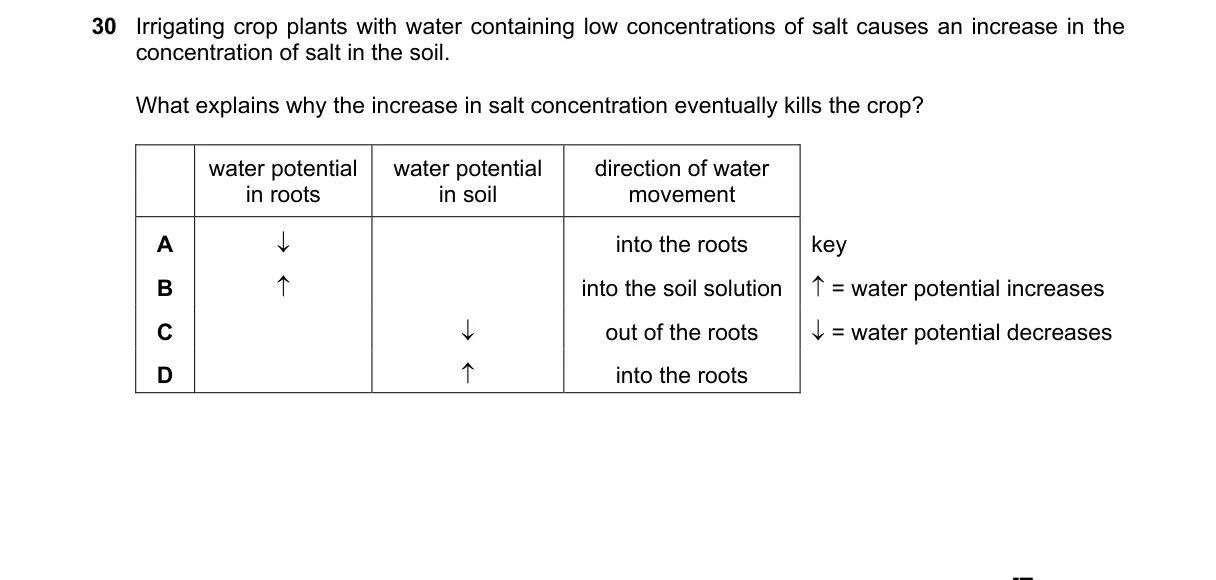
Irrigating crop plants with water containing low concentrations of salt causes an increase in the concentration of salt in the soil. What explains why the increase in salt concentration eventually kills the crop?
Answer choices
- A↑ water potential in roots, water movement into the soil, ↑ water potential increases
- B↑ water potential in soil, water movement into the roots, water potential increases
- C↓ water potential in roots, water movement out of the roots, ↓ water potential decreases
- D↓ water potential in soil, water movement into the roots, water potential decreases
Explanation
Osmotic stress from soil salinity impairs plant water uptake
Steps:
- Salt buildup in soil decreases soil water potential due to solutes.
- Water moves osmotically from higher potential in roots to lower in soil.
- This outflow dehydrates roots, further lowering root water potential.
- Sustained low water potential causes wilting and cell damage, killing the crop.
Why C is correct:
- Water potential (ψ) decreases with solute concentration (ψ_s = -iCRT); soil salt lowers ψ_soil, driving water out of roots (ψ_root > ψ_soil), exacerbating root dehydration.
Why the others are wrong:
- A: Salt raises, not lowers, solute effects; water moves to soil, not into it from roots.
- B: Soil ψ decreases, not increases; water moves out of roots, not into them.
- D: Water moves out of roots to soil, not into roots; root ψ decreases, not soil's effect directly.
Final answer: C
Topic: Transport mechanisms
Practice more A Levels Biology (9700) questions on mMCQ.me