A Levels Biology (9700)•9700/13/M/J/19
A Levels Biology (9700) — 9700/13/M/J/19, Question 28
The base sequence on the DNA strand coding for a polypeptide is shown.
CCA TTC GGC TTA GCA
Which mutation would have no effect on the polypeptide synthesized?
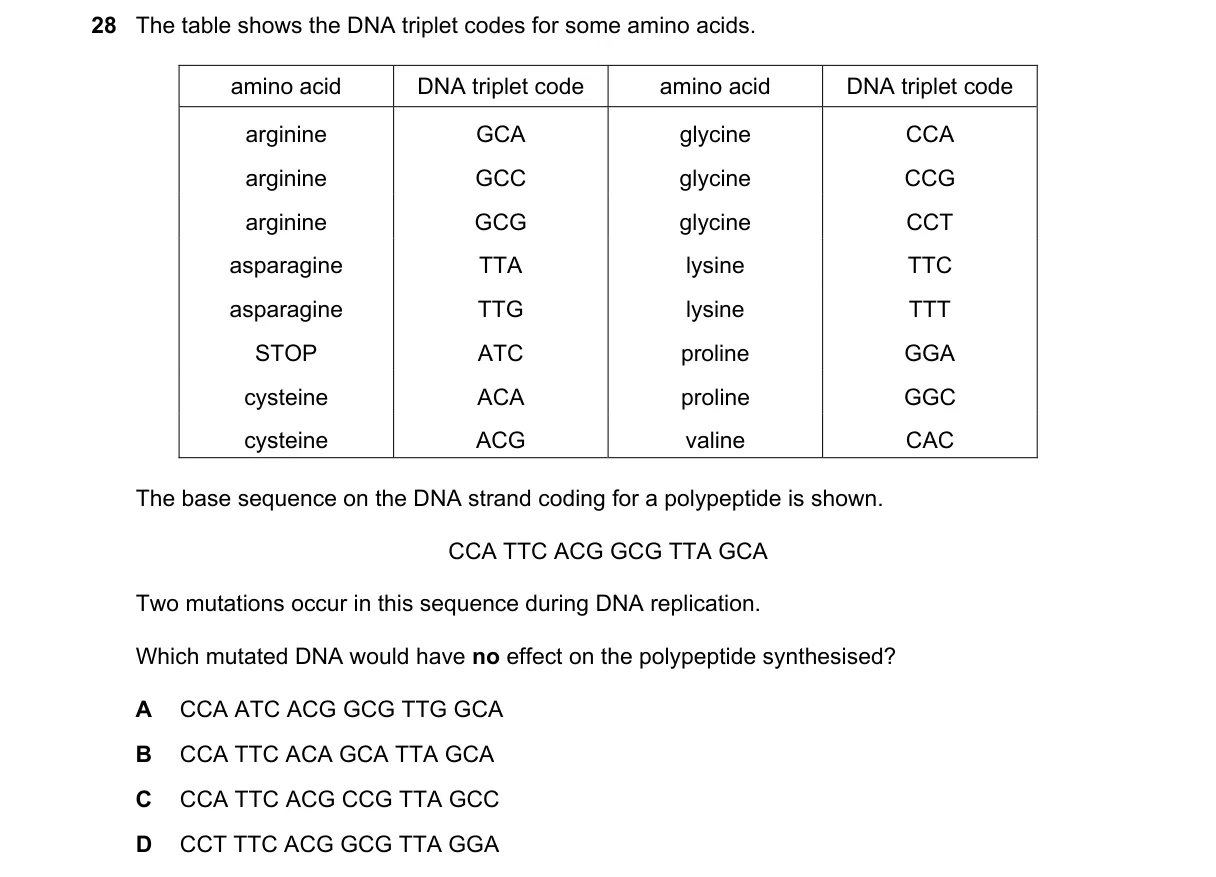
Answer choices
- ACCA ATC GGC TTG GCA
- BCCA TTC GCA TTA GCA
- CCTT TCG GCG TTG GAA
- DCCT TCG GCG TTG GAA
Explanation
Silent Mutation Steps:
- Divide sequences into 5 codons of 3 bases each, assuming coding strand (T to U for mRNA equivalent).
- Translate codons to amino acids using standard genetic code: original CCA (Pro), TTC (Phe), GGC (Gly), TTA (Leu), GCA (Ala).
- Compare each option's amino acid sequence to original Pro-Phe-Gly-Leu-Ala.
- Identify option with identical sequence, indicating no change in polypeptide.
Why B is correct:
- Third codon GGC (Gly) mutates to GGA (Gly), a silent mutation due to degeneracy in the genetic code's third ("wobble") position.
Why the others are wrong:
- A: Second codon TTC (Phe) to ATC (Ile), missense mutation changes amino acid.
- C: First codon CCA (Pro) to CTT (Leu), plus other changes like third GGC (Gly) to GCG (Ala), alters multiple amino acids.
- D: Second codon TTC (Phe) to TCG (Ser), plus others like fifth GCA (Ala) to GAA (Glu), alters multiple amino acids.
Final answer: B
Topic: Protein synthesis
Practice more A Levels Biology (9700) questions on mMCQ.me