A Levels Biology (9700)•9700/13/M/J/19
A Levels Biology (9700) — 9700/13/M/J/19, Question 27
Meselson and Stahl investigated DNA replication in bacteria. They grew bacteria in a medium with only heavy nitrogen, 15N, until all of the bacterial DNA was heavy. These bacteria were moved from a heavy nitrogen medium and cultured in a medium with only light nitrogen, 14N. A sample of bacteria was collected from the second generation and their DNA analyzed. Hybrid DNA contains both heavy and light strands. Which row shows both the percentage of heavy DNA strands and the percentage of hybrid DNA molecules in the second generation produced in the medium containing light nitrogen?
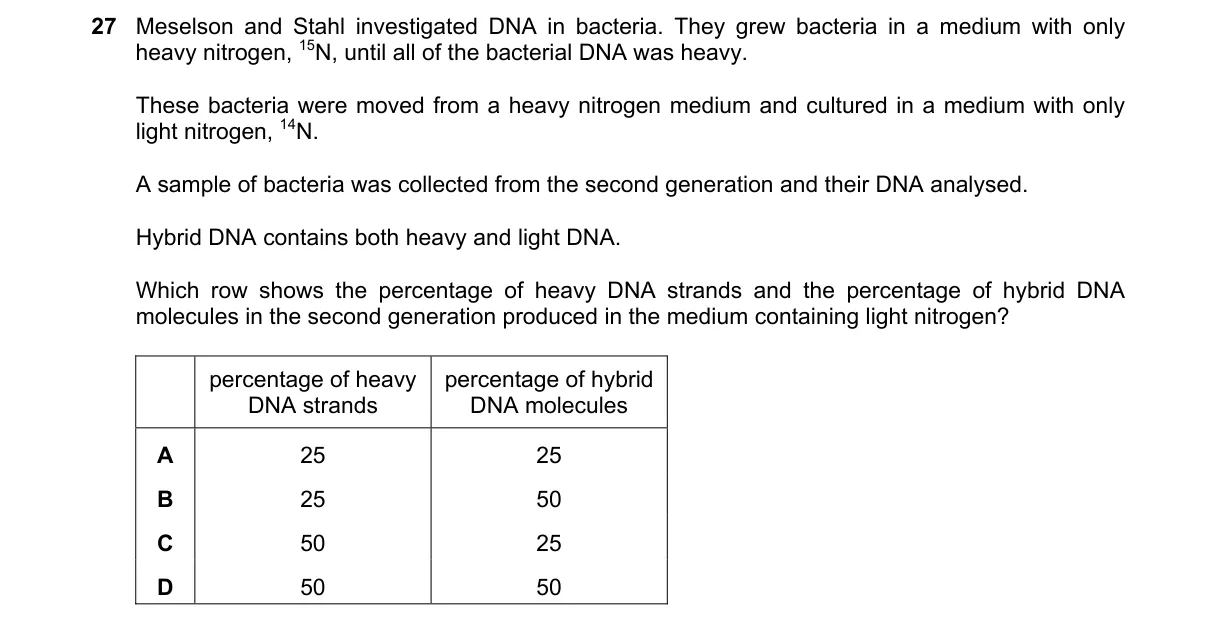
Answer choices
- A25 25
- B50 25
- C25 50
- D50 50
Explanation
Semi-conservative DNA replication distributes strands predictably across generations Steps:
- Generation 0: All DNA is heavy-heavy (HH); 100% heavy strands.
- Generation 1 in 14N: Each HH replicates to two hybrid (HL) molecules; 100% hybrid molecules, 50% heavy strands.
- Generation 2: Each HL replicates to one HL and one LL; results in 50% hybrid molecules (2 HL out of 4 total) and 25% heavy strands (one heavy strand per HL, across 8 total strands). Why C is correct:
- Semi-conservative replication ensures each new molecule retains one parental strand; after two generations, heavy strands comprise 25% of total strands (from hybrids only), while hybrid molecules are 50% of total. Why the others are wrong:
- A: Both percentages too low; ignores semi-conservative distribution.
- B: Swaps values; 50% applies to hybrid molecules, not heavy strands.
- D: Both too high; no fully heavy molecules remain after two generations.
Final answer: C
Topic: Structure of nucleic acids and replication of DNA
Practice more A Levels Biology (9700) questions on mMCQ.me