A Levels Biology (9700)•9700/13/M/J/19
A Levels Biology (9700) — 9700/13/M/J/19, Question 24
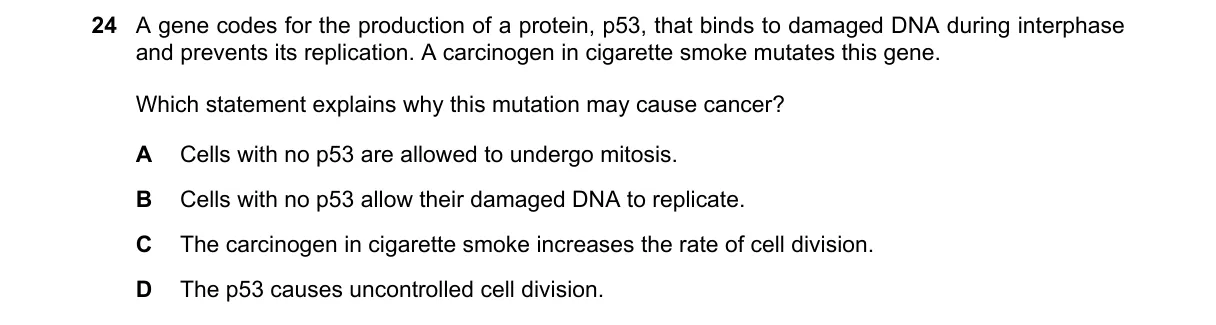
A gene codes for the production of a protein, p53, that binds to damaged DNA during interphase and prevents its replication. A carcinogen in cigarette smoke mutates this gene. Which statement explains why this may cause cancer?
Answer choices
- ACells with no p53 are allowed to undergo mitosis
- BCells with no p53 allow their damaged DNA to replicate
- CThe p53 causes uncontrolled cell division rate
- DThe p53 causes uncontrolled cell division
Explanation
p53's Role in Preventing DNA Replication Errors
Steps:
- p53 protein detects damaged DNA in interphase and halts replication to allow repair.
- Mutation from carcinogen inactivates p53, removing the checkpoint.
- Damaged DNA then replicates, leading to mutations in daughter cells.
- Accumulated mutations disrupt cell cycle control, promoting cancer.
Why B is correct:
- p53 acts as a tumor suppressor by enforcing the G1/S checkpoint (definition from cell biology), so its absence allows replication of damaged DNA, accumulating oncogenic mutations.
Why the others are wrong:
- A: Mitosis occurs after S phase; p53 primarily blocks DNA replication, not directly mitosis.
- C: Mutated p53 does not cause division; intact p53 prevents it.
- D: p53 inhibits, rather than causes, uncontrolled division.
Final answer: B
Topic: Replication and division of nuclei and cells
Practice more A Levels Biology (9700) questions on mMCQ.me