A Levels Biology (9700)•9700/13/M/J/19
A Levels Biology (9700) — 9700/13/M/J/19, Question 20
A student weighed a cylinder of potato and then put it into a test-tube containing a salt solution. The student weighed a cylinder removed from the salt solution after one hour. It was blotted dry and then weighed. The student recorded that the potato had lost mass. Which shows the correct explanation for the lost mass.
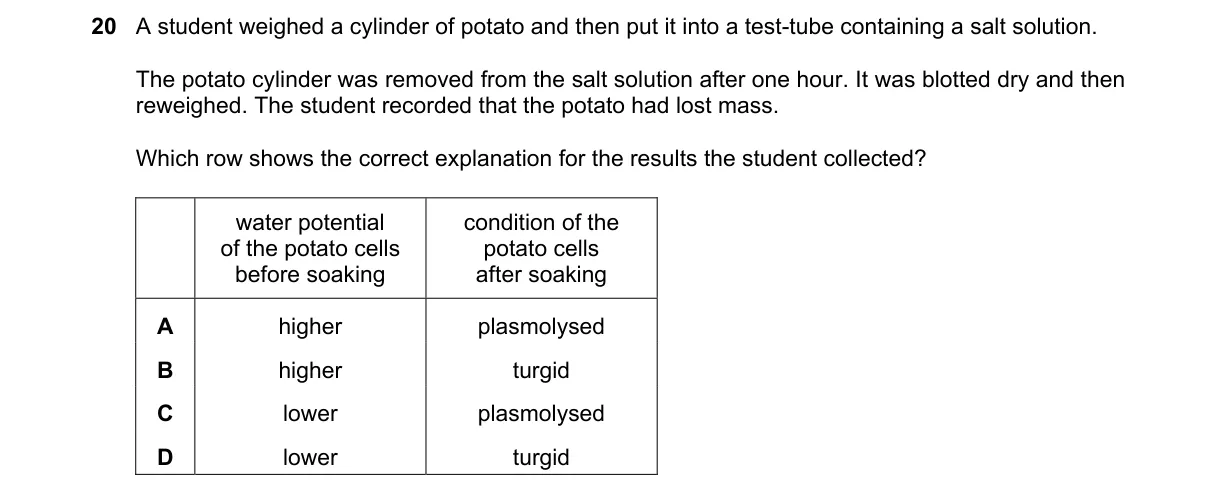
Answer choices
- Ahigher water potential of potato cells before soaking, plasmolysed after soaking
- Bhigher water potential of potato cells, turgid
- Clower water potential of potato cells, plasmolysed
- Dlower water potential of potato cells, turgid
Explanation
Osmosis drives water loss from potato cells in hypertonic salt solution
Steps:
- Potato cylinder loses mass after soaking in salt solution, indicating net water outflow from cells.
- Salt solution is hypertonic, with lower water potential than potato cells initially.
- Water moves by osmosis from higher water potential (potato) to lower (solution).
- This outflow causes cell membranes to pull away from walls, resulting in plasmolysis and mass reduction.
Why A is correct:
- Potato cells start with higher water potential than the solution, so water exits via osmosis (defined as diffusion of water across a semi-permeable membrane down a water potential gradient), leading to plasmolysis.
Why the others are wrong:
- B: Higher water potential would cause water entry, making cells turgid and gaining mass, not losing it.
- C: Lower water potential in potato would draw water in, preventing plasmolysis and mass loss.
- D: Lower water potential would promote water uptake, causing turgidity rather than mass loss.
Final answer: A
Topic: Movement into and out of cells
Practice more A Levels Biology (9700) questions on mMCQ.me