A Levels Biology (9700)•9700/13/M/J/19
A Levels Biology (9700) — 9700/13/M/J/19, Question 19
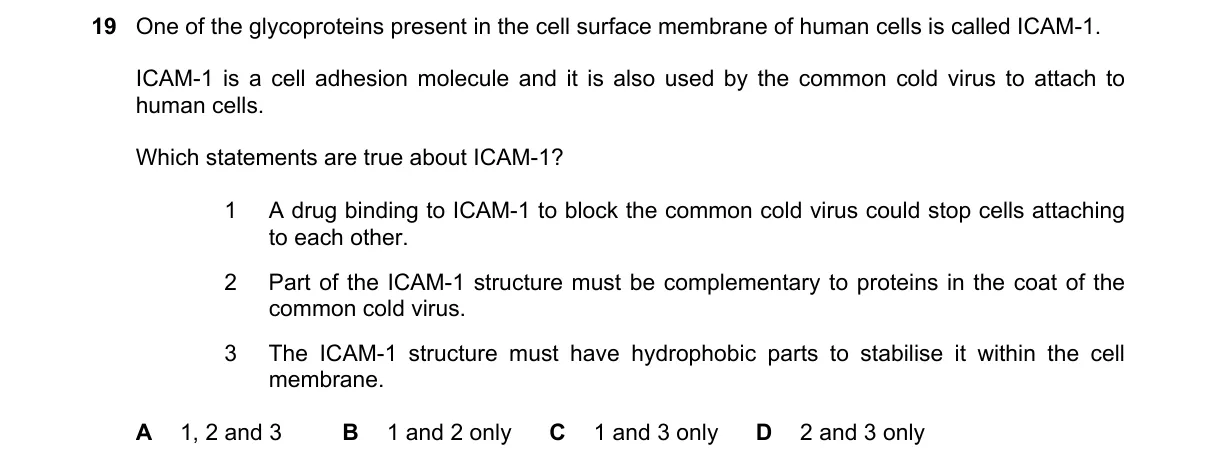
ICAM-1 is an adhesion molecule in the cell surface membrane of human cells. It is also used by the common cold virus to attach to human cells.
Which statements are true about ICAM-1?
1. A drug binding to ICAM-1 to block the common cold virus could stop cells attaching to each other.
2. The ICAM-1 structure must be complementary to proteins in the coat of the virus.
3. The ICAM-1 structure must have hydrophobic parts to stabilise it within the cell membrane.
Answer choices
- A1, 2 and 3
- B1 and 2
- C1 and 3 only
- D2 and 3 only
Explanation
ICAM-1's roles in adhesion, viral attachment, and membrane structure
Steps:
- Statement 1 is true: ICAM-1 mediates cell-cell adhesion, so blocking it with a drug would also prevent cells from attaching to each other.
- Statement 2 is true: Viral attachment requires specific binding, so ICAM-1's structure must complement viral coat proteins like a lock and key.
- Statement 3 is true: As a transmembrane protein, ICAM-1 embeds in the lipid bilayer, requiring hydrophobic regions for stability.
- All three statements hold, confirming option A.
Why A is correct:
- ICAM-1 functions as both an intercellular adhesion molecule and a viral receptor, with its structure governed by biochemical principles of specific binding (statement 2) and membrane integration via hydrophobic interactions (statement 3), while its adhesion role implies blocking effects (statement 1).
Why the others are wrong:
- B omits statement 3, but hydrophobic parts are essential for membrane proteins.
- C omits statement 2, but complementary structures enable specific viral binding.
- D omits statement 1, but ICAM-1's adhesion function means blocking it affects cell attachment.
Final answer: A
Topic: Fluid mosaic membranes
Practice more A Levels Biology (9700) questions on mMCQ.me