A Levels Biology (9700)•9700/12/M/J/19
A Levels Biology (9700) — 9700/12/M/J/19, Question 8
In enzyme-catalysed reactions, the position of the amino acids found at the active site is important. During synthesis of enzymes, amino acids are brought together in the correct position to form the active site. Which level of protein structure must be involved in forming the active site?
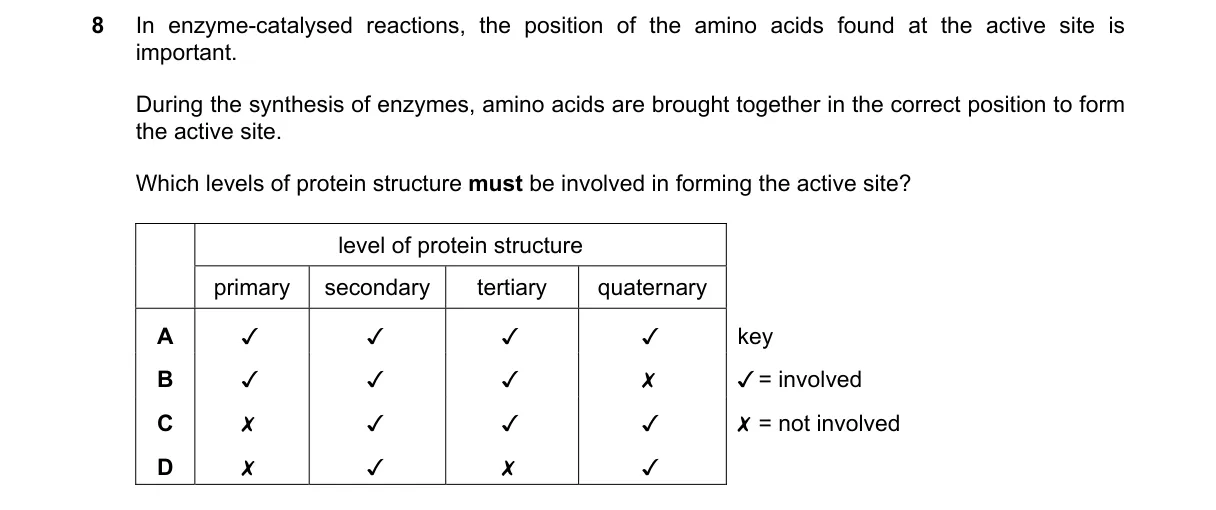
Answer choices
- Aprimary ✓ secondary ✓ tertiary ✓ quaternary ×
- Bprimary × secondary ✓ tertiary ✓ quaternary ✓
- Cprimary × secondary ✓ tertiary × quaternary ✓
- Dprimary × secondary × tertiary × quaternary ×
Explanation
Active Site Formation via Protein Folding Levels
Steps:
- Primary structure is the linear amino acid sequence, which sets the foundation but does not position residues spatially for the active site.
- Secondary structure forms local folds like alpha helices and beta sheets, positioning nearby residues correctly.
- Tertiary structure folds the chain into a 3D shape, bringing distant residues together to create the active site.
- Quaternary structure assembles multiple polypeptide chains, allowing active site formation across subunits in multisubunit enzymes.
Why B is correct:
- Active site requires spatial arrangement of residues via secondary (local motifs), tertiary (overall fold), and quaternary (subunit interactions) structures, per protein folding hierarchy.
Why the others are wrong:
- A includes primary (sequence alone lacks 3D positioning) and excludes quaternary (needed for multisubunit enzymes).
- C excludes tertiary (essential for 3D pocket formation).
- D excludes all higher levels (ignores folding necessary for active site).
Final answer: B
Topic: Proteins
Practice more A Levels Biology (9700) questions on mMCQ.me