A Levels Biology (9700)•9700/12/M/J/19
A Levels Biology (9700) — 9700/12/M/J/19, Question 3
Two different types of cell P and Q were broken up using ultrasound and their contents analyzed. Both types of cell contained small circular DNA. The circular DNA from P had the same base sequence, but those from Q were of two types with different base sequences. What may be concluded about the identity of cell types P and Q?
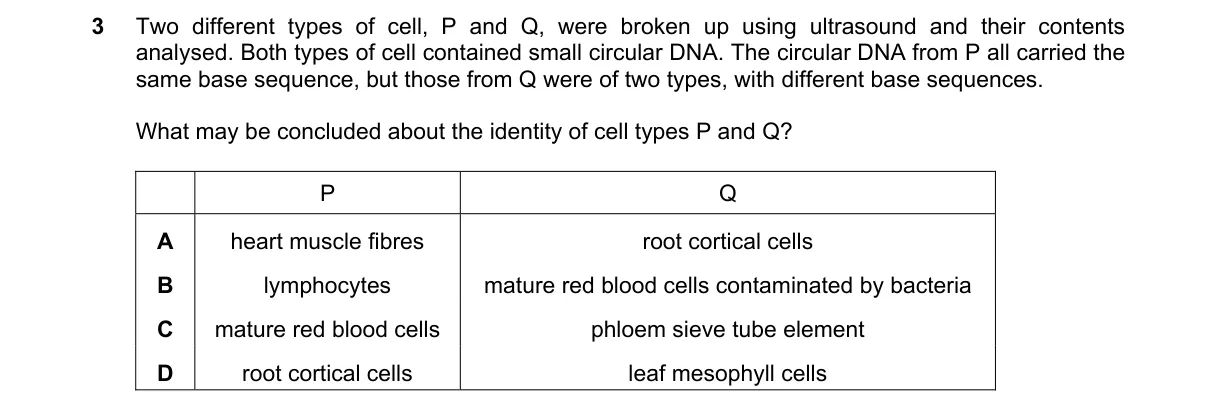
Answer choices
- Aheart muscle fibres ; mature red blood cells containing bacteria
- Bmature blood cells ; phloem sieve tube element by bacteria
- Croot cortical cells ; leaf mesophyll cells
- Droot cortical cells ; leaf mesophyll cells
Explanation
Circular DNA in Plant Cells Steps:
- Identify small circular DNA as mitochondrial or chloroplast genomes in eukaryotic cells.
- Note that P has uniform DNA sequence, indicating one organelle type (mitochondria only).
- Note that Q has two different DNA sequences, indicating two organelle types (mitochondria and chloroplasts).
- Match to plant cells: roots lack chloroplasts, leaves have both.
Why D is correct:
- Leaf mesophyll cells contain chloroplasts (unique cpDNA) and mitochondria (mtDNA), yielding two distinct circular DNAs; root cortical cells have only mtDNA with identical sequences.
Why the others are wrong:
- A: Mature red blood cells lack organelles and DNA; heart cells have only uniform mtDNA, no bacterial involvement.
- B: Mature blood cells lack DNA; phloem sieve tubes lack nuclei but not dual circular DNAs from bacteria.
- C: Identical to D, but assumes no distinction in cell types for dual DNA.
Final answer: D
Topic: Cells as the basic units of living organisms
Practice more A Levels Biology (9700) questions on mMCQ.me