A Levels Biology (9700)•9700/12/M/J/19
A Levels Biology (9700) — 9700/12/M/J/19, Question 29
The diagram shows the pathway for the transport of carbon dioxide that occurs in red blood cells. Which row is correct?
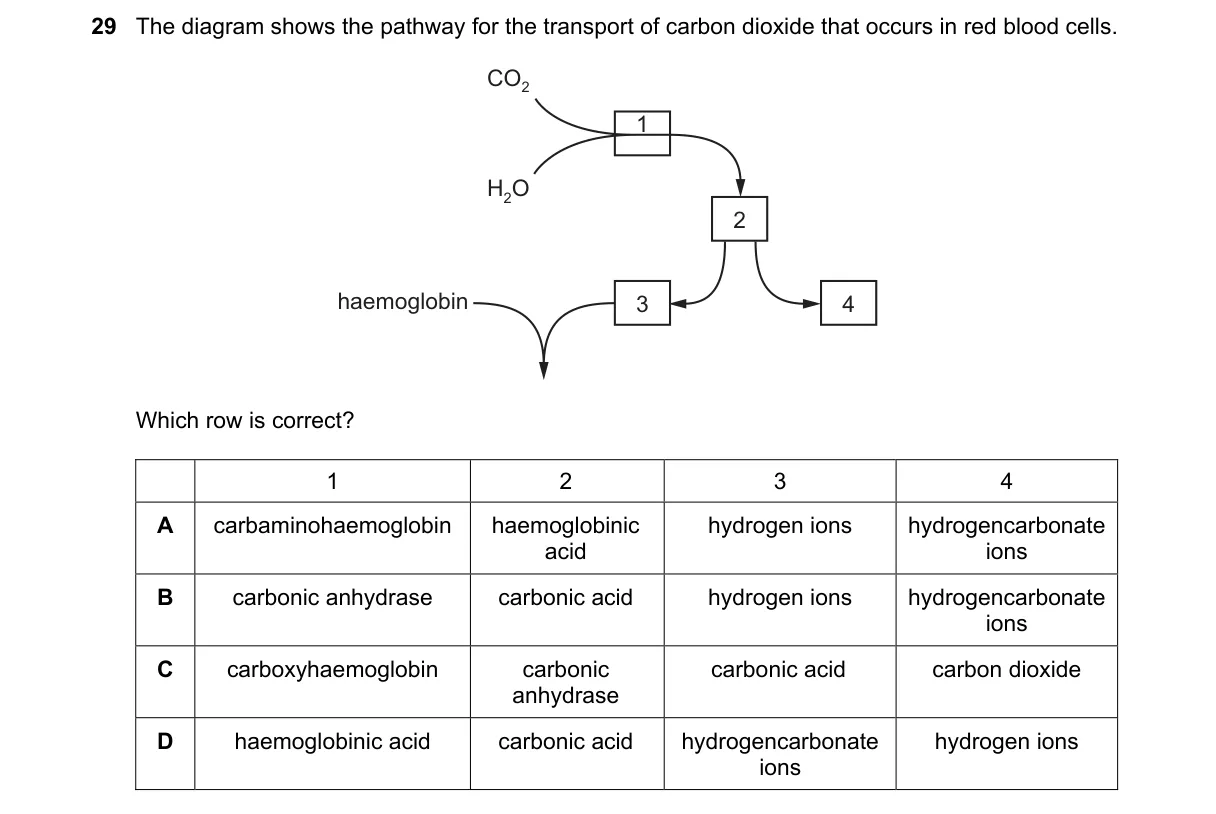
Answer choices
- Acarbaminohemoglobin haemoglobin hydrogen ions hydrogen carbonate
- Bcarbonic anhydrase carbonic hydrogen ions hydrogen carbonate
- Ccarboxyhaemoglobin carbonic carbonic acid carbon dioxide
- Dhaemoglobin acid carbonic acid hydrogen ions hydrogen carbonate
Explanation
CO2 to bicarbonate conversion in red blood cells
Steps:
- CO2 diffuses into red blood cells from tissues.
- Carbonic anhydrase enzyme catalyzes CO2 + H2O to form carbonic acid.
- Carbonic acid dissociates into hydrogen ions (H+) and hydrogen carbonate ions (HCO3-).
- HCO3- exits the cell via chloride shift for blood transport.
Why B is correct:
- Matches the reaction: CO2 + H2O ⇌ H2CO3 ⇌ H+ + HCO3-, catalyzed by carbonic anhydrase, the primary CO2 transport pathway.
Why the others are wrong:
- A: Describes carbaminohemoglobin formation, a minor CO2 binding to hemoglobin, not the main enzymatic pathway.
- C: Carboxyhemoglobin involves CO poisoning, not CO2 transport; includes irrelevant carbon dioxide reversal.
- D: Starts with hemoglobin and "acid," misrepresenting the enzyme-driven process without carbonic anhydrase.
Final answer: B
Topic: Transport of oxygen and carbon dioxide
Practice more A Levels Biology (9700) questions on mMCQ.me