A Levels Biology (9700)•9700/12/M/J/19
A Levels Biology (9700) — 9700/12/M/J/19, Question 25
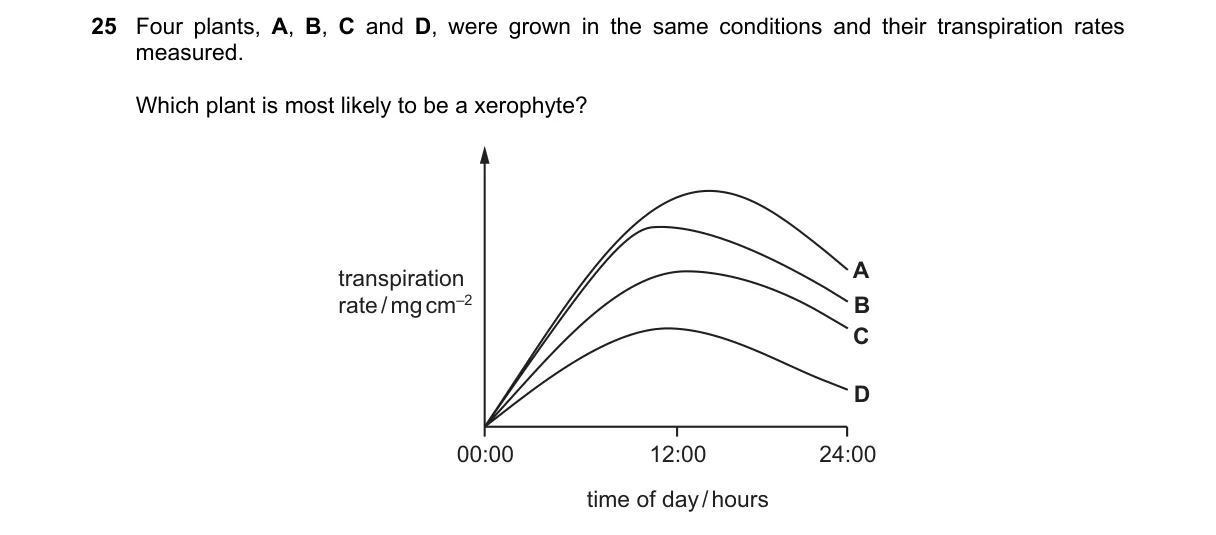
Four plants, A, B, C and D, were grown in the same conditions and their transpiration rates measured. Which plant is most likely to be a xerophyte?
Answer choices
- AOption A
- BOption B
- COption C
- DOption D
Explanation
Xerophytes minimize transpiration to conserve water in dry environments
Steps:
- Define xerophyte: A plant adapted to arid conditions with features reducing water loss.
- Recall transpiration: Rate of water evaporation from leaves, higher in mesophytes, lower in xerophytes.
- Compare rates: Under identical conditions, the plant with the lowest transpiration rate adapts best to drought.
- Identify D: It shows the lowest rate among A, B, C, and D.
Why D is correct:
- Xerophytes evolved low transpiration rates (e.g., via thick cuticles or sunken stomata) to survive water scarcity, matching D's minimal rate.
Why the others are wrong:
- A: High rate indicates mesophyte, not drought-adapted.
- B: Moderate rate suggests typical plant, not xerophyte.
- C: Elevated rate implies hydrophyte or mesophyte traits.
Final answer: D
Topic: Transport mechanisms
Practice more A Levels Biology (9700) questions on mMCQ.me