A Levels Biology (9700)•9700/12/M/J/19
A Levels Biology (9700) — 9700/12/M/J/19, Question 22
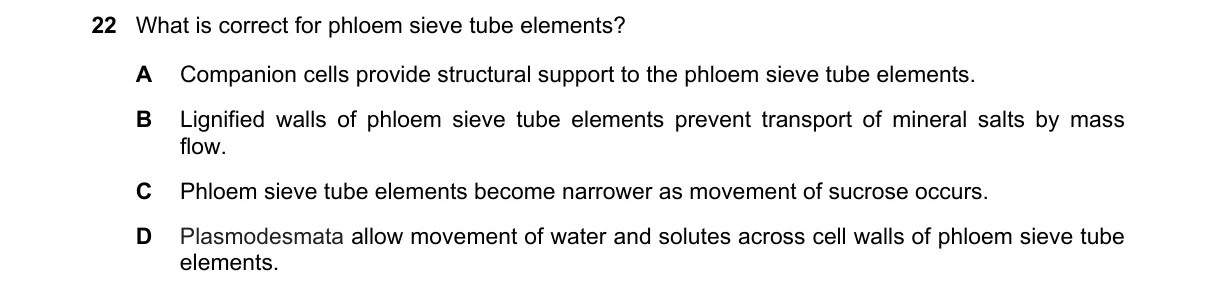
What is correct for phloem sieve tube elements?
Answer choices
- ACompanion cells provide structural support
- BLignified walls of phloem sieve tube elements prevent transport of mineral salts by mass flow
- CPhloem sieve tube elements become narrower as movement of sucrose occurs.
- DPlasmodesmata allow movement of water and solutes across cell walls of phloem sieve tube elements.
Explanation
Phloem Sieve Tube Connectivity
Steps:
- Sieve tube elements form phloem conduits for sucrose transport, lacking nuclei and relying on adjacent cells.
- They connect end-to-end via sieve plates with pores derived from plasmodesmata for symplastic flow.
- Companion cells link to sieve tubes through plasmodesmata, enabling solute exchange.
- Evaluate options against phloem's non-lignified, living structure for mass flow.
Why D is correct:
- Plasmodesmata are cytoplasmic channels that connect adjacent plant cells, allowing symplastic movement of water and solutes between sieve tube elements and companion cells as defined in plant cell communication.
Why the others are wrong:
- A: Companion cells supply metabolic support and loading, not structural support, which is provided by xylem.
- B: Phloem sieve tubes have non-lignified walls to facilitate flexible transport; mass flow occurs for sugars and minerals via pressure gradients.
- C: Sieve tube diameter remains constant; narrowing does not occur during sucrose movement.
Final answer: D
Topic: Structure of transport tissues
Practice more A Levels Biology (9700) questions on mMCQ.me