A Levels Biology (9700)•9700/12/M/J/19
A Levels Biology (9700) — 9700/12/M/J/19, Question 12
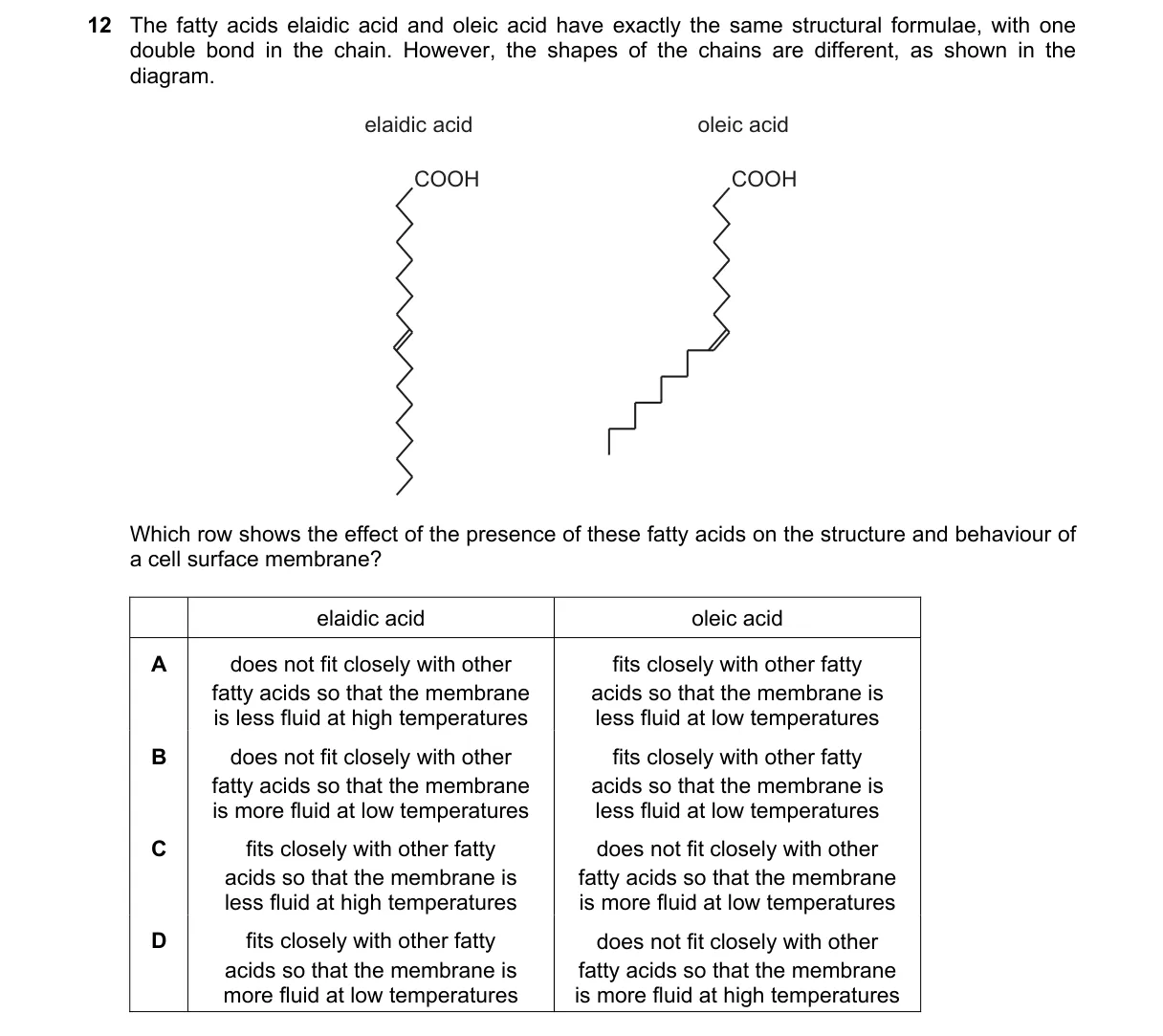
Which row shows the effect of the presence of these fatty acids on the structure and behaviour of a cell surface membrane?
Answer choices
- AElaidic acid does not fit closely with other fatty acids so the membrane is more fluid at low temperatures. Oleic acid fits closely with other fatty acids so the membrane is less fluid at low temperatures.
- BElaidic acid fits closely with other fatty acids so the membrane is more fluid at low temperatures. Oleic acid does not fit closely with other fatty acids so the membrane is less fluid at low temperatures.
- CElaidic acid fits closely with other fatty acids so the membrane is less fluid at low temperatures. Oleic acid does not fit closely with other fatty acids so the membrane is more fluid at low temperatures.
- DElaidic acid does not fit closely with other fatty acids so the membrane is less fluid at low temperatures. Oleic acid fits closely with other fatty acids so the membrane is more fluid at low temperatures.
Explanation
Fatty Acid Shape and Membrane Fluidity
Steps:
- Identify elaidic acid as trans-unsaturated (straight chain) and oleic acid as cis-unsaturated (kinked chain).
- Recall that straight chains pack tightly, reducing fluidity; kinked chains pack loosely, increasing fluidity.
- At low temperatures, tight packing solidifies the membrane faster, decreasing fluidity.
- Match to options: elaidic fits closely (less fluid), oleic does not (more fluid).
Why C is correct:
- Trans fats like elaidic align linearly, maximizing van der Waals interactions for tighter packing and lower fluidity per fluid mosaic model.
Why the others are wrong:
- A: Reverses both effects; elaidic packs tightly, not loosely.
- B: Swaps fluidity outcomes; elaidic reduces, not increases, fluidity.
- D: Inverts fitting and fluidity; elaidic fits closely for less, not more, fluidity.
Final answer: C
Topic: Fluid mosaic membranes
Practice more A Levels Biology (9700) questions on mMCQ.me