A Levels Biology (9700)•9700/11/M/J/19
A Levels Biology (9700) — 9700/11/M/J/19, Question 15
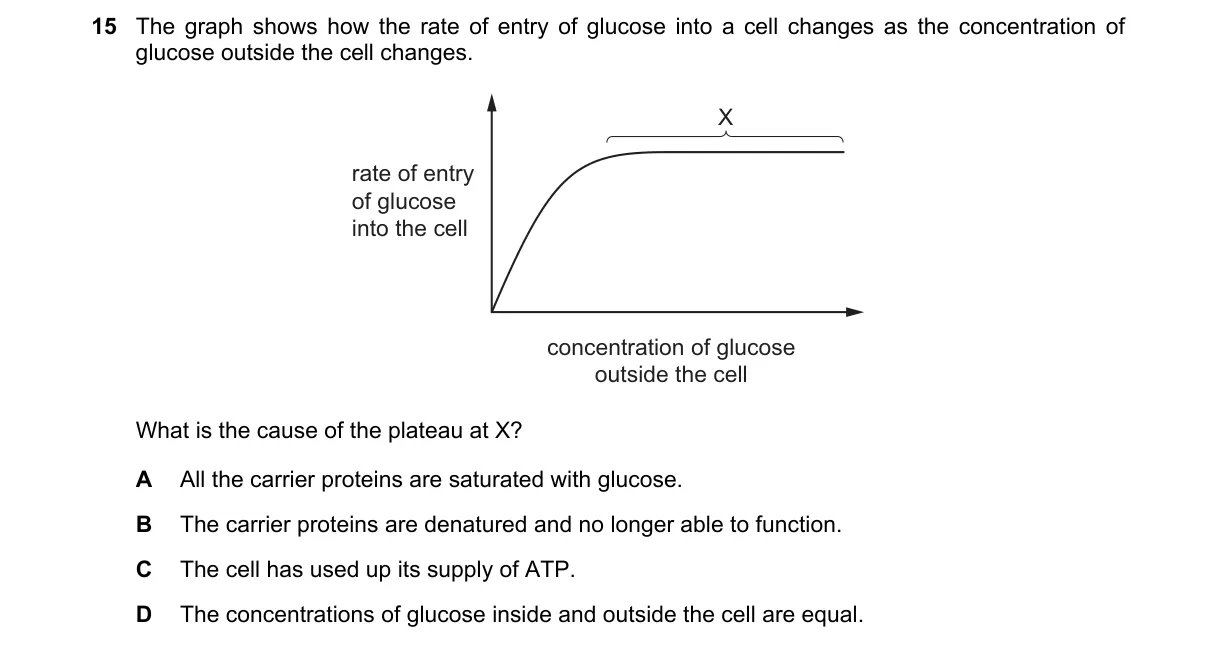
The graph shows how the rate of entry of glucose into a cell changes as the concentration of glucose outside the cell changes. What is the cause of the plateau?
Answer choices
- AAll the carrier proteins are saturated with glucose.
- BThe carrier proteins are denatured and no longer able to function.
- CThe concentrations of glucose inside and outside the cell are equal.
- DThe carrier proteins have used up their supply of ATP.
Explanation
Carrier Protein Saturation in Facilitated Diffusion
Steps:
- Identify the graph as showing facilitated diffusion kinetics for glucose transport.
- Note the plateau represents the maximum transport rate (Vmax).
- Recognize that Vmax occurs when all carrier proteins are fully occupied.
- Conclude the plateau is due to saturation of available carriers.
Why A is correct:
- In facilitated diffusion, the transport rate follows Michaelis-Menten kinetics, where saturation (all carriers bound) limits the rate to Vmax regardless of higher substrate concentration.
Why the others are wrong:
- B: Denaturation would eliminate transport entirely, not create a sustained plateau.
- C: Equal concentrations indicate equilibrium with zero net transport, not a maximum rate plateau.
- D: Glucose entry via carriers (e.g., GLUT proteins) is passive facilitated diffusion, not ATP-dependent active transport.
Final answer: A
Topic: Movement into and out of cells
Practice more A Levels Biology (9700) questions on mMCQ.me