A Levels Biology (9700)•9700/13/M/J/18
A Levels Biology (9700) — 9700/13/M/J/18, Question 6
Which size range would include most prokaryotic cells?
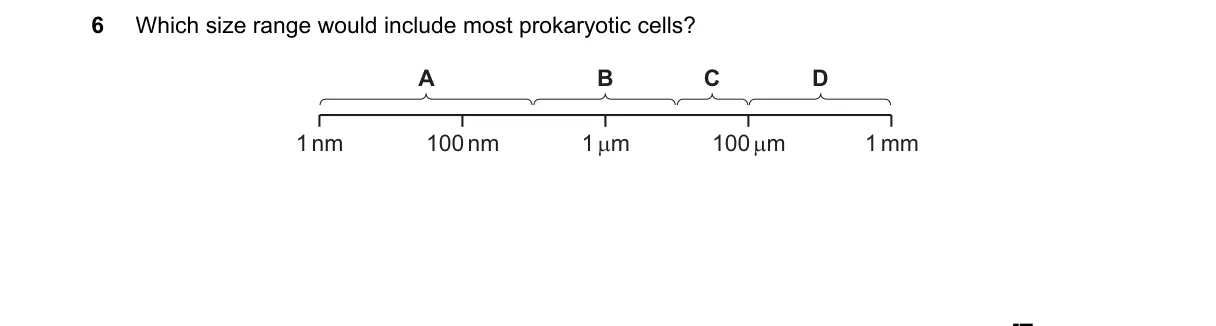
Answer choices
- A1 nm to 100 nm
- B100 nm to 1 μm
- C1 μm to 100 μm
- D100 μm to 1 mm
Explanation
Prokaryotic cells typically measure 0.1–5 μm
Steps:
- Prokaryotes like bacteria range from 0.1 μm (100 nm) to about 5–10 μm in length or diameter.
- Most common sizes fall between 0.2 μm and 2 μm, with many under 1 μm.
- Convert units: 1 μm = 1,000 nm, so option B spans 0.1–1 μm.
- Compare ranges: B captures the majority of typical prokaryotic sizes.
Why B is correct:
- Prokaryotic cells are defined as unicellular organisms without nuclei, typically 0.1–1 μm for most bacteria like E. coli (about 0.5–2 μm but averaging under 1 μm in width).
Why the others are wrong:
- A: Too small; 1–100 nm covers viruses and macromolecules, not cells.
- C: Too large; 1–100 μm includes eukaryotic cells like animal cells (10–100 μm).
- D: Much too large; 100 μm–1 mm is visible to the naked eye, like some protists or multicellular structures.
Final answer: B
Topic: Cells as the basic units of living organisms
Practice more A Levels Biology (9700) questions on mMCQ.me