A Levels Biology (9700)•9700/13/M/J/18
A Levels Biology (9700) — 9700/13/M/J/18, Question 32
What explains how maximum uptake of oxygen occurs as blood passes through the capillaries of the lungs?
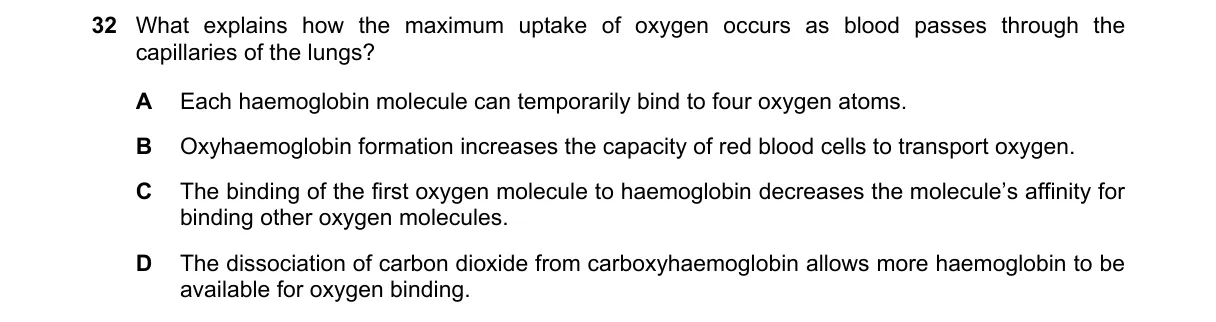
Answer choices
- AEach haemoglobin formation increases the capacity of red blood cells to transport oxygen.
- BOxyhaemoglobin formation increases the affinity of haemoglobin for other oxygen molecules.
- CThe binding of the first oxygen molecule to haemoglobin decreases the molecule's affinity for
- DThe dissociation of carbon dioxide from carboxyhaemoglobin allows more haemoglobin to be available for oxygen binding.
Explanation
Cooperative Oxygen Binding in Hemoglobin
Steps:
- Identify the process: Oxygen uptake in lungs involves hemoglobin binding up to four O2 molecules efficiently.
- Recall hemoglobin's structure: It has four subunits; binding is cooperative, not independent.
- Analyze choices: Look for the mechanism enabling rapid, maximum saturation in high-oxygen lung environment.
- Select best fit: Option describing increased affinity after initial binding matches cooperative effect.
Why B is correct:
- Cooperative binding (positive allostery) in hemoglobin: Binding the first O2 induces conformational change (T to R state), raising affinity for subsequent O2 molecules, per the sigmoidal oxygen-hemoglobin dissociation curve.
Why the others are wrong:
- A: Hemoglobin formation doesn't alter red blood cell capacity; each cell has fixed hemoglobin amount.
- C: Opposite of reality—first O2 binding increases, not decreases, affinity for more O2.
- D: Carboxyhemoglobin involves carbon monoxide, not CO2; CO2 transport is mainly as bicarbonate, not via dissociation for O2.
Final answer: B
Topic: Transport of oxygen and carbon dioxide
Practice more A Levels Biology (9700) questions on mMCQ.me