A Levels Biology (9700)•9700/13/M/J/18
A Levels Biology (9700) — 9700/13/M/J/18, Question 23
DNA polymerase catalyses condensation reactions between molecules during semi-conservative replication of DNA. Which two molecules are joined by DNA polymerase?
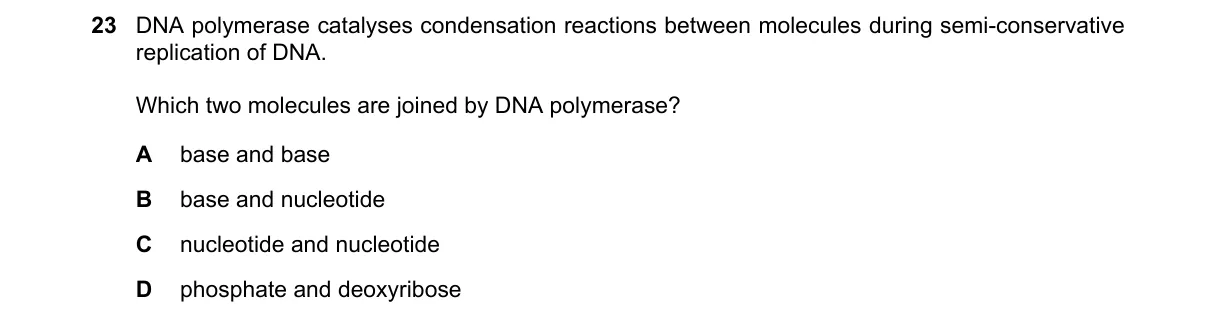
Answer choices
- Atwo base molecules
- Bbase and nucleotide
- Cnucleotide and nucleoside
- Dphosphate and deoxyribose
Explanation
DNA Polymerase Joins Nucleotides via Phosphodiester Bonds
Steps:
- DNA replication involves adding deoxynucleoside triphosphates (dNTPs, nucleotides) to the 3' end of the growing DNA strand.
- The condensation reaction forms a phosphodiester bond by linking the 5' phosphate of the incoming nucleotide to the 3' hydroxyl group of the deoxyribose sugar on the previous unit.
- The previous unit's end functions as a nucleoside (base + sugar) after phosphate release.
- Thus, DNA polymerase joins a nucleotide to the nucleoside at the chain's 3' end.
Why C is correct:
- Nucleotides (base + sugar + phosphate) are the monomers added; the 3' end acts as a nucleoside (base + sugar), matching the definition of DNA polymerization.
Why the others are wrong:
- A: Bases are not directly joined; they pair via hydrogen bonds, not condensation.
- B: Bases are components, not standalone molecules joined by polymerase.
- D: Phosphate and deoxyribose form nucleotides but are not the primary molecules linked in replication.
Final answer: C
Topic: Structure of nucleic acids and replication of DNA
Practice more A Levels Biology (9700) questions on mMCQ.me