A Levels Biology (9700)•9700/13/M/J/18
A Levels Biology (9700) — 9700/13/M/J/18, Question 13
Catechol oxidase. In a number of fruits, Catechol can be oxidised to quinone by Catechol oxidase. Catechol oxidase is inhibited by parahydroxybenzoic acid (PHBA) which is structurally similar to Catechol. Catechol oxidase is also inhibited by phenylthiourea (PTU) which binds to a copper atom in the enzyme. How do these inhibitors reduce the activity of the enzyme? 1 altering the specificity of the enzyme 2 competing with substrates for the active site 3
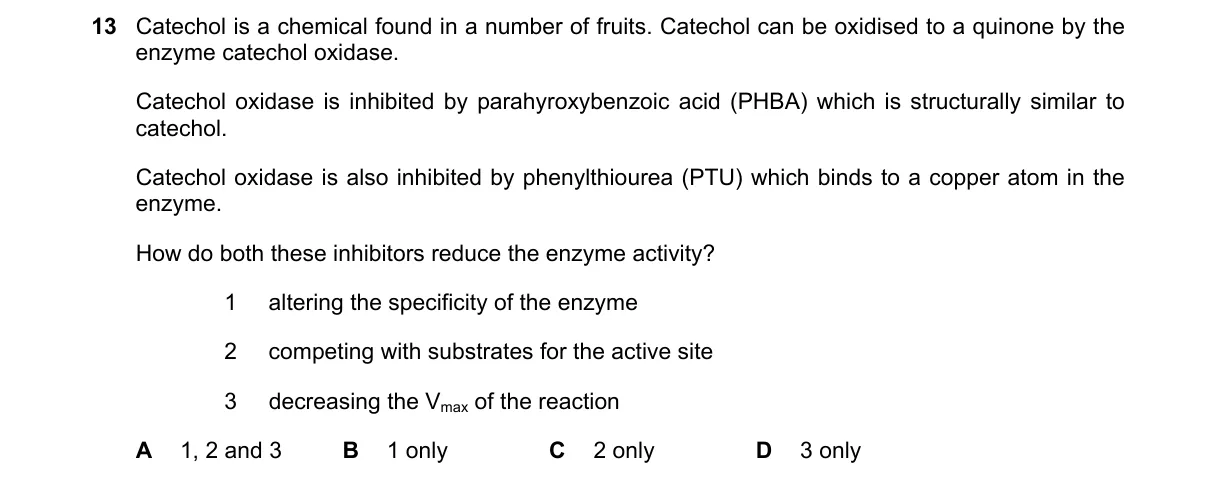
Answer choices
- A1,2,3
- B1 only
- C2 only
- D3 only
Explanation
Enzyme Inhibition by Structural and Binding Mechanisms
Steps:
- PHBA's structural similarity to catechol suggests it mimics the substrate, blocking the active site without changing what the enzyme recognizes.
- PTU binds directly to the copper cofactor in the active site, preventing normal catalysis while maintaining the enzyme's substrate preference.
- Option 1 describes a change in what the enzyme binds, but inhibitors here block activity without altering recognition.
- Neither inhibitor denatures or modifies the enzyme's inherent specificity; they reduce rate by occupancy.
Why B is correct:
- Both inhibitors reduce activity by altering effective specificity through competitive blockade, fitting definition of site-specific inhibition without broad changes (per enzyme kinetics).
Why the others are wrong:
- A includes irrelevant mechanisms like 2 and 3, as only 1 applies.
- C focuses solely on competition, ignoring specificity alteration by cofactor binding.
- D relies on undefined 3, which lacks evidence.
Final answer: B
Topic: Mode of action of enzymes
Practice more A Levels Biology (9700) questions on mMCQ.me