A Levels Biology (9700)•9700/12/M/J/18
A Levels Biology (9700) — 9700/12/M/J/18, Question 40
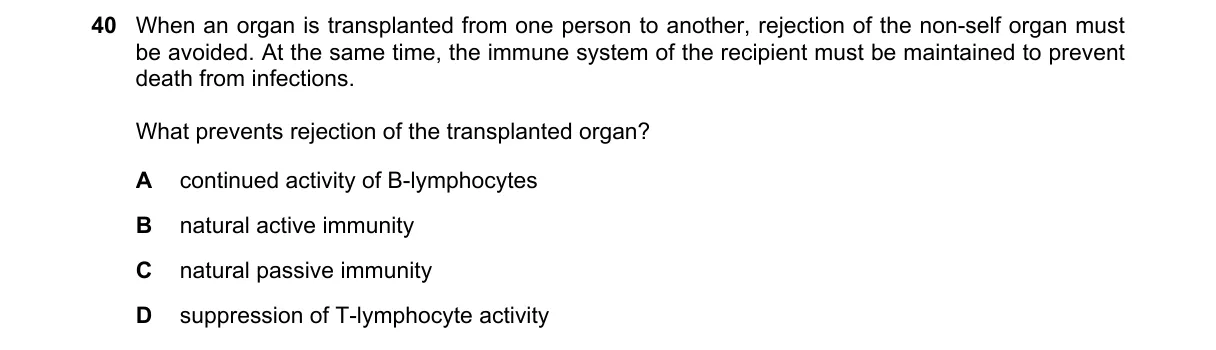
When an organ is transplanted from one person to another, rejection of the non-self organ must be avoided. At the same time, the immune system of the recipient must be maintained to prevent death from infections. What prevents rejection of the transplanted organ?
Answer choices
- Acontinued activity of B-lymphocytes
- Bnatural active immunity
- Cnatural passive immunity
- Dsuppression of T-lymphocyte activity
Explanation
T-cell suppression prevents transplant rejection
Steps:
- Transplant rejection occurs when the recipient's immune system identifies the donor organ as foreign.
- T-lymphocytes (T-cells) are key players in cell-mediated immunity that attack non-self tissues.
- Immunosuppressive drugs target T-cell activity to block this response.
- This allows the organ to be accepted while balancing infection risk through controlled suppression.
Why D is correct:
- T-lymphocytes drive acute rejection via cytotoxic T-cells that directly kill foreign cells, so their suppression (e.g., via drugs like cyclosporine) prevents organ damage per immunological principles of adaptive immunity.
Why the others are wrong:
- A: B-lymphocytes produce antibodies for humoral immunity, which can contribute to rejection but aren't the primary target for prevention.
- B: Natural active immunity builds long-term protection against pathogens, not transplants, and would worsen rejection.
- C: Natural passive immunity transfers pre-formed antibodies (e.g., from mother to child), irrelevant to suppressing transplant responses.
Final answer: D
Topic: The immune system
Practice more A Levels Biology (9700) questions on mMCQ.me